

Gym walls fail for three reasons: equipment and bags scuff them, sweat and cleaning wear the film down, and skipped prep lets paint lift in sheets. Durable gym walls come from a scuff-resistant interior latex in a washable sheen, applied over properly prepared and fully cured surfaces, in a color that forgives marks. Get those four things right and a gym wall can go years between touch-ups. We paint commercial and residential interiors across the GTA, and the details below are what we would want a gym owner, property manager or home gym builder to know before approving a scope.
TL;DR
- Choose a scuff-resistant interior latex rather than a standard wall paint, in eggshell or satin for most gym walls. Higher sheens clean more easily; flat shows marks.
- Surface prep decides lifespan. The APCA notes that most paint failures trace back to poor or insufficient prep.
- Respect cure times: scuff-resistant latex typically needs about two weeks before cleaning chemicals touch it.
- Dark or deep colors hide marks but mar more easily in low-sheen finishes, so they need extra coats and the right sheen.
- Well-painted interior walls typically last 5 to 10 years before touch-ups, and high-traffic zones need attention sooner.
Table of Contents
- What actually wears out a gym wall
- The best paint type for gym walls
- Choosing the sheen
- Prep and application: where durability is won
- Color and durability
- How long gym paint lasts
- Cleaning and maintaining painted gym walls
- Who this matters for
- Our perspective
- Get your gym walls painted properly
- FAQ
- Sources
What actually wears out a gym wall
A gym is harder on paint than almost any other interior. Walls take knocks from dumbbells, kettlebells, medicine balls, bag straps and shoes. Sweat and humidity sit on surfaces. Staff wipe down walls repeatedly. Each of these attacks the paint in a different way, and no single property of a paint covers all of them.
A continuing-education article on scuff-resistant coatings explains the central tension well. Cleaning is itself a mechanical process that erodes paint film. Scrub-resistant coatings such as epoxies hold up to cleaning but still get scuffed. Scuff-resistant latex works the other way: marks do not grip the film, so they wipe off with soap and water, which keeps maintenance light.
That gives you two separate ideas to keep straight:
- Scuff resistance is how well a paint resists taking on marks in the first place.
- Washability or scrub resistance is how well it survives being cleaned. Scrub resistance is measured in cycles under the ASTM D2486 test, and the same article notes that ordinary latex in higher sheens cleans better but still does not effectively resist scuffs.
For gym walls you want both, and the most direct way to get there is a coating designed for scuffs, in a sheen that cleans easily.
The best paint type for gym walls
Scuff-resistant latex for most rooms
For commercial and home gyms alike, a scuff-resistant, one-component interior latex is the practical default. Manufacturers of this category name gymnasiums and locker rooms as intended uses. One Canadian product page for a scuff-resistant latex describes patented scuff-resistant technology, low VOCs (volatile organic compounds, the fumes that make fresh paint smell), quick drying and resistance to repeated washing, in four finishes from matte to semi-gloss.
Latex also suits occupied buildings. A technical data sheet for the same type of product lists one hour to touch and two to three hours to recoat at 25 °C and 50% relative humidity. For a gym that cannot close for long, that means walls can be finished in a day or two rather than waiting on slow-curing systems.
The same data sheet says the product is not recommended for floors. Walls and floors are different jobs; if your gym floor or garage slab needs a coating, that is a separate system, such as epoxy floor coatings.
When epoxy makes sense
The APCA’s painting tips guide says high-traffic interiors such as schools, offices and hotels need coatings with more resistance to marking and burnishing (the shiny, polished patches that appear where surfaces get rubbed). It adds that high-performance latex finishes beat institutional low-odor, low-VOC systems on that front, and that epoxy coatings suit aggressive interiors with constant cleaning, detergents or high moisture, such as indoor pools. In a gym, that points to epoxy for wet zones such as shower and pool-deck walls, and high-performance latex for the training floor, studios and corridors.
Concrete and masonry walls
Basement gyms and garage gyms often mean concrete or block walls. A Canadian painting specification for concrete walls and ceilings lists a sealer followed by two coats of an eggshell scuff-resistant latex. The principle carries over: bare masonry gets a sealer or primer first, never finish coats straight onto the surface.
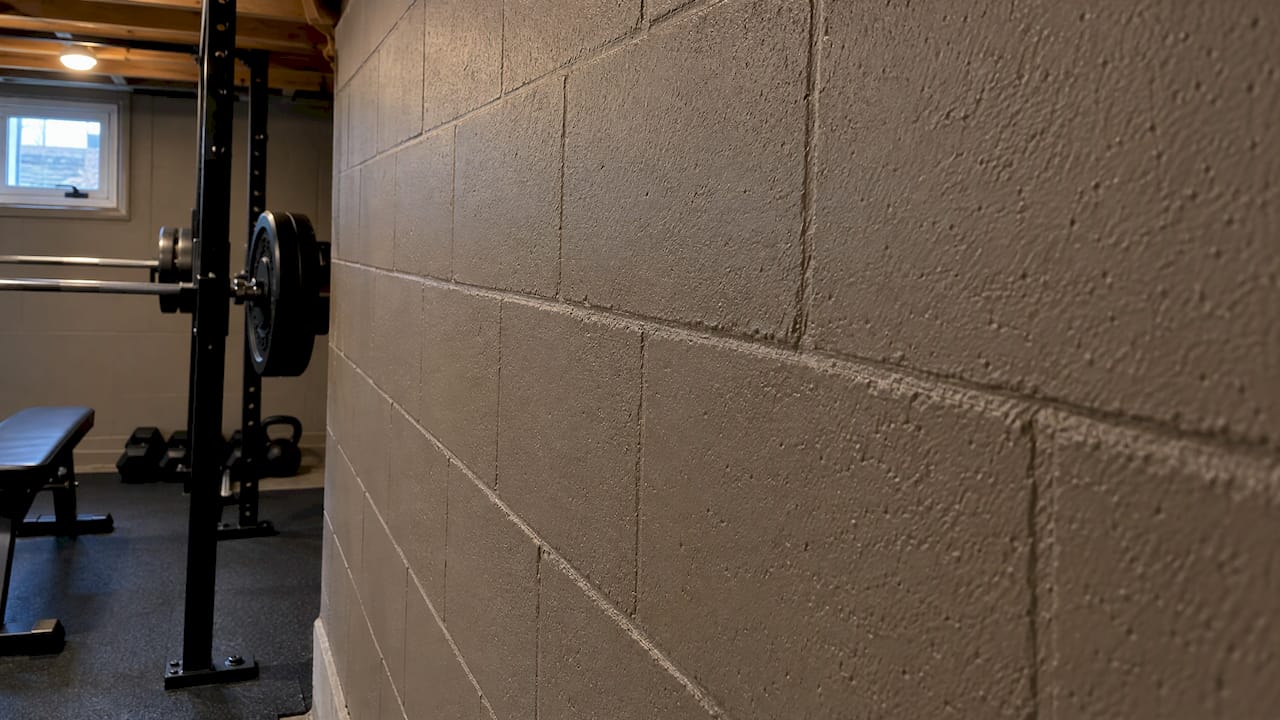
One caution from the other direction: FacilitiesNet warns that impermeable coatings can trap moisture behind the film and cause peeling and delamination. Below-grade walls that carry moisture need the right product choice and a moisture check, not just a tougher paint.
Choosing the sheen
Sheen is how glossy the dried paint looks, and it drives both cleanability and how much marks show.
| Sheen | Cleanability | Best gym use |
|---|---|---|
| Flat/matte | Lowest; rated medium-low durability for low-traffic walls and ceilings | Ceilings, low-contact areas |
| Eggshell | Good, low glare | Most training-floor walls |
| Satin | Very good, easy to clean | Heavy-use walls, corridors, entries |
| Semi-gloss | Best, but shows wall flaws | Trim, doors, locker rooms, wet zones |
The sheen guide on a Canadian interior paint page rates satin as an easy-to-clean finish for moderate- to high-traffic areas, and flat as medium-low durability for low-traffic walls and ceilings. A gym color guide lands in the same place: eggshell as the all-around choice, satin for heavy-use walls.
Higher sheen has a visual cost. Glossier paint highlights every dent, roller mark and drywall seam, so it demands better surface prep. That is one reason we treat finishing as a system, not a can of paint. Our guide to high-end paint finishes covers how sheen changes the look of a wall, and our note on ceiling paint versus wall paint explains why ceilings can stay flat while walls should not.
For trim, doors and mirrors’ frames, which take the hardest knocks, see our guide to trim paint for a durable finish.
Prep and application: where durability is won
The APCA states that most paint failures are directly related to improper and insufficient surface preparation, which usually shows up as poor adhesion. A top-tier paint over a dirty or glossy wall peels sooner than a mid-grade paint over a well-prepared one.
Here is what proper prep involves for a gym wall, based on the data sheet requirements:
- Clean thoroughly. Surfaces must be clean, dry and free of dirt, grease, soap, wax, scaling paint and mildew. Gym walls pick up body oils, chalk residue and cleaning-product film, all of which block adhesion.
- Repair damage. Dents, anchor holes from old racks and shelving, and gouges need filling and sanding. Peeling paint is sanded to feathered edges so the repair does not telegraph through.
- Dull glossy areas. Existing glossy paint needs scuff-sanding so the new coat can grip.
- Let new masonry or plaster cure. The data sheet calls for 30 days before the base coat on new plaster or masonry.
- Prime where needed. Bare drywall patches, stains and masonry need the correct primer or sealer.
- Apply the right number of coats. Two finish coats is the baseline. Deep colors need more, as covered below.
Conditions matter too. The MPI interior painting specification (Master Painters Institute, whose standards are widely used in Canadian commercial work) requires interior air and substrate temperatures above set minimums for 24 hours before, during and after painting, no painting above 85% relative humidity, and a maximum of 12% moisture in plaster and gypsum board. Gyms hold humidity, so this is a real constraint, particularly in basements. Our article on humidity and interior painting goes through how to judge it.
Product-specific limits apply as well: the data sheet gives a minimum application temperature of 10 °C for both air and surface. In a Toronto winter, an unheated garage gym or a building with the heat turned down does not meet that.
If the gym is in an occupied building, protecting the floors and equipment matters as much as the paint. See our tips on floor protection during painting.
Color and durability
Color is not only mood. It changes how fast a wall looks worn.
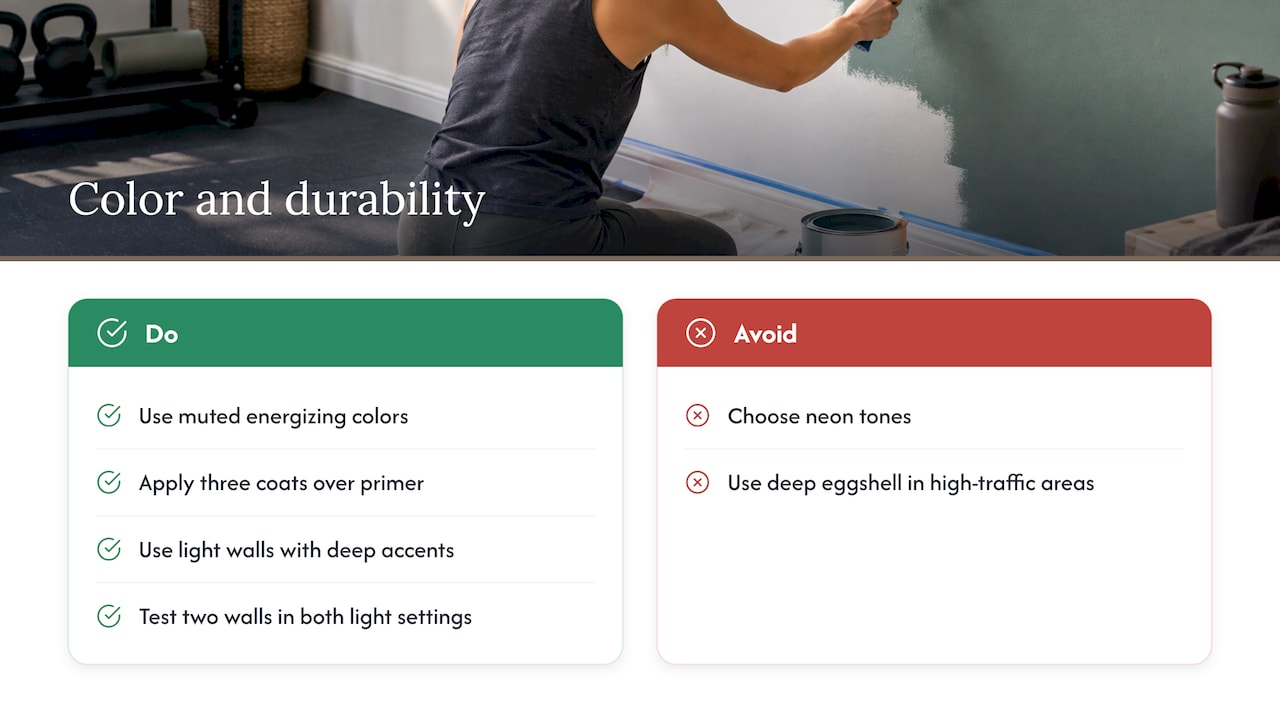
Deep neutrals such as charcoal and navy hide scuffs and equipment marks better than light colors, according to Samplize’s home gym color guide, which suggests pairing dark paint with matte or eggshell finishes and good lighting so the room does not feel closed in. Muted versions of energizing colors also age better than neon tones.
There is a technical catch. The MPI maintenance repainting specification notes that deep tinted colors in flat, eggshell or semi-gloss finishes mar easily in high-traffic areas, with loss of sheen and lower abrasion resistance. It recommends at least three finish coats over primer for deep or high-contrast accent colors. So if you choose charcoal behind the rack, budget for the extra coat and pick the paint system accordingly.
A practical scheme many gym owners like: a light, high-reflectance color on most walls to keep the room bright, with a deep accent behind the squat rack or dumbbell area where the marks land. Test samples on at least two walls, in morning light and evening gym lighting, and beside the flooring and equipment. The color you see in the store is rarely the color you see under 4000K to 5000K LEDs.
How long gym paint lasts
FacilitiesNet reports that well-painted interior walls in commercial or residential buildings typically last 5 to 10 years before touch-ups, while high-traffic areas such as hallways and entryways need attention more often. Lifespan depends on substrate preparation, application method, and product quality and selection.
For a gym, treat that range as a ceiling for quiet zones. A commercial floor with constant equipment traffic, shared bags and daily wipe-downs should be inspected annually. A garage or basement home gym with a handful of users can sit at the long end.
Signs it is time to touch up or repaint:
- Burnished, shiny patches where bags or backs rub.
- Scuffs that no longer wipe away with soap and water.
- Chipping at corners, door frames and behind racks.
- Bubbling or peeling near showers, sinks or exterior walls, which points to a moisture source that must be fixed first. Our guide on stopping bathroom mildew from returning applies equally to locker-room walls.
Cleaning and maintaining painted gym walls
The maintenance notes on the data sheet are specific: a scuff-resistant latex needs a full two-week cure before any cleaning chemicals or liquids are used, minimal scuffs and stains come off with soap and water, and stronger cleaners should be tried first in an inconspicuous spot. Another Canadian paint product page gives a longer window for its washable film, four weeks before cleaning with a mild non-abrasive liquid detergent. The sensible rule: follow the data sheet of whatever was applied, and schedule the grand opening or the first deep clean after the cure period, not before.
Day to day, use a soft cloth or sponge, mild soap and water, and no abrasive pads. Keep a labelled can of the exact color and sheen for touch-ups, and record the date, so repairs match.
Who this matters for
- Commercial gym and studio owners and property managers: schedule repainting during low-traffic windows and plan cure time before cleaning contracts resume.
- Condo boards and HOAs: amenity-room gyms see steady use by many residents; durable, washable walls reduce touch-up cycles in common areas.
- Landlords, developers and short-term rental hosts: a finished home gym or fitness room adds appeal, and scuff-resistant walls protect it between tenants or guests.
- Homeowners and pre-listing sellers: a basement or garage gym that is freshly painted and in a neutral color shows better than one with equipment ghosts on the walls.
Our perspective
Gym clients usually ask us which paint to buy. The better question is who is going to prep and apply it, because the wall tells the truth about the preparation years later.
What we see as the difference-maker is the sequence: cleaning, repairs, sanding, priming, then coats applied in conditions the product allows. When we scope a job, we put premium materials and thorough prep and cleanup first, because a scuff-resistant coating cannot bond to a greasy, chalky or damp surface.
We also think color should be decided with durability in mind. That is why we include a complimentary color consultation: a charcoal feature wall behind the racks hides marks, but it needs the right coat count and sheen. Our estimates are free and fixed, and our work carries a written workmanship warranty, so you know the price and the result before the first drop cloth goes down.
Enrico
Get your gym walls painted properly
We paint interiors for homeowners, builders, landlords, property managers and commercial clients across the GTA, from a single room to a full commercial unit. Our interior painting service includes comprehensive prep and cleanup, premium materials and a complimentary color consultation. For a fast starting point on scope and cost, use our quote calculator, or see everything we do on our services page.

If your gym also needs wall repairs before painting, such as drywall patches, water-damage repair or anchor-hole filling, those are part of our services list too, so one crew can take the wall from damaged to finished.
FAQ
What type of paint is best for a home gym?
A scuff-resistant interior latex in eggshell or satin suits most home gyms. It wipes clean with soap and water and handles the knocks from weights and bags. Concrete basement or garage walls need a sealer or primer first.
Is flat paint okay in a gym?
Flat paint works on ceilings and low-contact walls, but it is rated medium-low durability and shows marks readily. For walls where equipment and people make contact, eggshell or satin is a better balance of washability and low glare.
How long should gym wall paint last?
Well-painted interior walls typically last 5 to 10 years before touch-ups, according to FacilitiesNet, though high-traffic areas need attention sooner. Surface prep, application and product selection set where in that range a gym lands.
When can I clean freshly painted gym walls?
Wait for the full cure. For one scuff-resistant latex the data sheet says two weeks before cleaning chemicals or liquids, and other washable paints specify up to four weeks. Check the data sheet for the product used.
Do dark colors hold up better in a gym?
Deep neutrals hide scuffs and marks better, but in low-sheen finishes they mar more easily. Plan for at least three finish coats over primer on deep accent colors, per the MPI repainting specification.
Sources
- Scuff-resistant interior latex product page (Canada)
- Scuff-resistant latex technical data sheet
- Canadian light commercial and residential painting specification
- APCA painting tips, February 2018
- MPI interior painting guide specification, April 2022
- MPI maintenance repainting guide specification, 2024
- FacilitiesNet: Determining a paint project’s lifespan
- CE Center: Scuff-resistant paint and long-term durability
- Canadian interior paint and primer product page
- Samplize: home gym paint colours
- The Decor Mag: how to choose colors for a gym


