

Yes, interior doors can be sprayed, and sprayed is the best-looking way to finish them. A sprayed door has no brush marks, an even sheen and a factory look, which is why designers, builders and sellers specify it. The result depends on three things: taking the doors off their hinges, choosing a true trim enamel, and controlling overspray and fumes in a lived-in space. Sigma Painting offers fine-finish and millwork spraying across the GTA, so the prep, masking and cleanup are handled for you.
TL;DR
- Spraying gives the smoothest door finish: no brush strokes, a uniform sheen and a factory look, especially on panel doors with recessed details.
- Doors sprayed flat, off the hinges, need far less masking and run less than doors sprayed in place.
- In Ontario, one 2026 rate guide prices a sprayed door at $140 and a brushed one at $110, before HST, two coats each.
- Use a trim enamel, not wall paint. Allow the label’s recoat time between coats and let the paint cure before rehanging.
- Indoor spraying means ventilation, a proper respirator and no ignition sources. Fine-finish crews plan for this before the first door comes off.
Table of Contents
- When spraying makes sense
- Spray versus roll and brush
- What spraying a door costs in Ontario
- Choose the right paint first
- How a sprayed door is done, step by step
- Safety when spraying indoors
- Where our spray work fits
- Spraying your doors with Sigma Painting
- Perspective
- FAQ
- Sources
When spraying makes sense
Spraying is worth it when finish quality is the point or when there are many doors. A sprayed surface has no brush marks and no roller stipple, and the sheen is the same from edge to edge. Most doors are not flat, either. Raised and inset panels, grooves and mouldings are difficult to coat evenly by hand, and a sprayer reaches them in one pass.
That is why spraying fits the people we work with most:
- Luxury homeowners who want doors and trim that look factory-finished next to new millwork.
- Builders and multi-unit developers with dozens or hundreds of doors that have to match from unit to unit.
- Pre-listing sellers, landlords and short-term rental owners who need a crisp, durable result on a deadline.
- Designers and home stagers who need doors to read as clean, uniform surfaces in photos and showings.
- Property managers and office managers with wood or painted doors in corridors, suites and boardrooms.
One trade-off is worth knowing. The same Ontario guide notes that spraying needs an empty house or a lot of masking, and a painter with an airless or HVLP rig (high-volume, low-pressure, a finer-atomizing sprayer). A brushed trim job in a good water-based alkyd enamel is a fine finish in an occupied home. If you want the factory look, spraying is the route, and the preparation around it is what makes it work.
Spray versus roll and brush
People ask whether it is better to spray or roll doors. Here is the practical comparison.
| Sprayed | Brushed and rolled | |
|---|---|---|
| Look | No brush marks, uniform sheen | Good in a quality enamel, but marks can show on panels |
| Panel and moulded doors | Reaches recesses evenly | Harder to keep even in recesses |
| Many doors | Fastest per door once set up | Slower, each door done by hand |
| Occupied home | Needs masking or an empty space | Easier to do in place |
| Typical Ontario rate, 2026 | $140 per door, before HST | $110 per door, before HST |
The rates come from Builders Ontario’s October 2026 cost guide. Both are for two coats, with the sprayed door off the hinges and the brushed door painted in place, both faces and edges. Painting over old oil enamel adds $30 per door in the same guide.
So the sprayed finish costs more per door, and for a hallway of panel doors or a full set of bedroom doors that premium is small compared with how much the doors stand out. They are touched daily and seen from every room.
What spraying a door costs in Ontario
The question searchers ask most is how much it costs to spray paint interior doors. For Ontario, the Builders Ontario guide gives the $140 sprayed figure above. A Canada-wide cost table lists interior door painting at $92 to $167 per unit across the sources it gathers, so you will see quotes spread across that range depending on door type, condition and the finish.
What moves the price on a real job:
- Door style. Flat slab doors are quick. Six-panel and shaker doors take more passes.
- Existing finish. Old oil enamel, heavy damage or dark colours that need priming add time.
- Quantity. More doors spread the setup cost.
- Casings and frames. Doors are often priced with or without the trim around them. Ask which one a quote covers.
- Occupancy. A vacant unit is simpler to spray than a furnished home.
Published figures are a guide. Sigma Painting does not publish door prices, because the right number depends on those factors. We give free, fixed, rapid estimates, so you know the price before work starts.
Choose the right paint first
The paint matters as much as the method. Wall paint on doors stays soft, scuffs and can stick to the door stop. A trim enamel cures harder. The Ontario guide puts the extra cost at about $20 a gallon, a small amount on a job of this size, and says the difference lasts years.
For a Canadian product example, Behr’s Alkyd Satin Enamel is formulated for doors and trim. Its label recommends two coats for durability, lists 2 to 4 hours to dry and 4 to 8 hours before recoating, and permits airless spraying with a .013 to .017 inch tip and a 60-mesh filter. It says not to thin the paint and to ventilate. Every product has its own numbers, so the can in your hand is the authority on thinning, tip size and timing.
The label also says to prime new wood and heavily stained surfaces before the topcoat, and to scuff-sand glossy surfaces. If you are weighing finishes for your trim and doors together, our guide to the best trim paint for a durable, factory-smooth finish goes deeper, and if the trim is MDF there is a separate walk-through on priming and finishing MDF trim. We use premium materials on every project, with a complimentary colour consultation, so sheen and colour are settled before anything is sprayed.
How a sprayed door is done, step by step
This is the routine a spray finish follows, and the points where it most often goes wrong.
1. Take the doors off
Remove the door from its hinges and take off the knob, latch and other hardware. Graco’s door and trim guide lays the door across two sawhorses. Spraying a door flat sharply cuts masking and reduces drips and sags, because gravity is no longer pulling wet paint down a vertical panel.
Where it goes wrong: doors get mixed up. Label each door and its hinge side so it goes back where it came from. When we paint a home, taking doors off and putting them back is part of the job, so you do not have to manage it.
2. Repair and clean
Fill dings, cracks and old hardware holes with putty, let it dry and sand it smooth, then wipe the door clean. Behr’s label asks for surfaces that are clean, sound, dry and free of dirt, oil and grease, with loose or peeling paint removed. Our guide on filling hardware holes shows the same repair logic on cabinet doors.
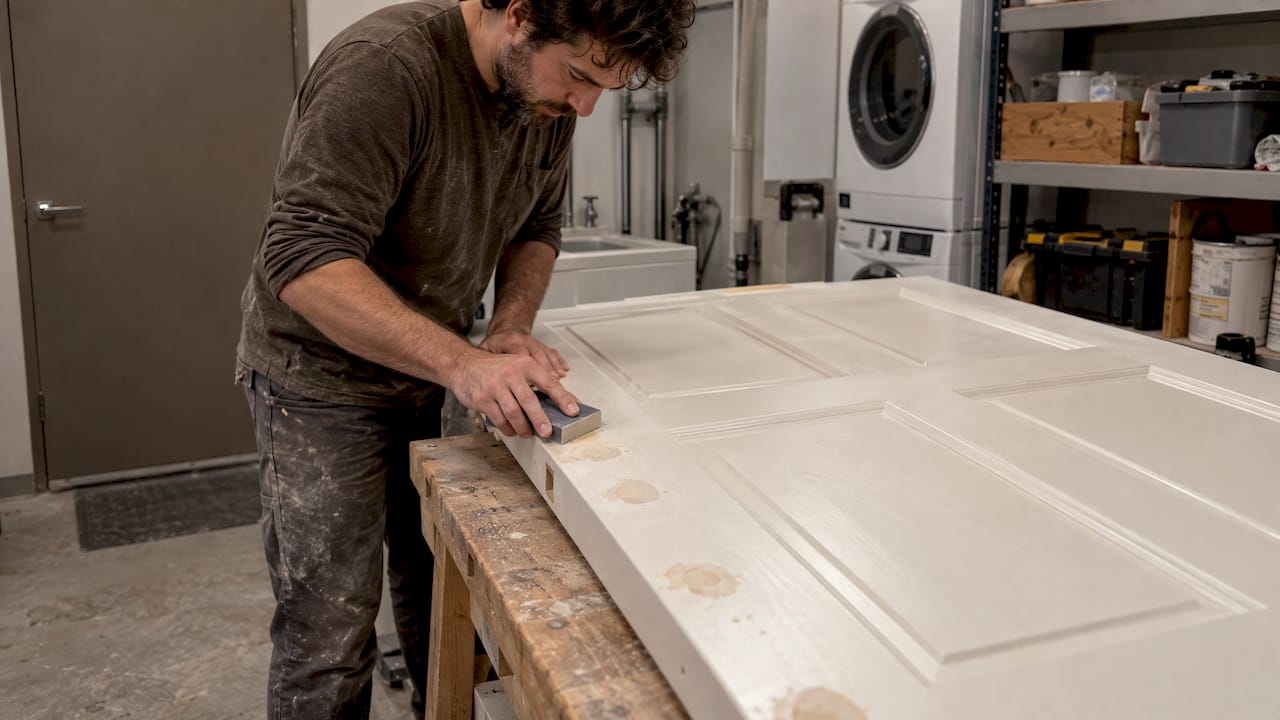
Where it goes wrong: spray magnifies every flaw. A small dent a roller would hide will show as a shadow under a glossy sprayed coat. Our service covers comprehensive prep, including drywall and surface repairs around the doors.
3. Scuff-sand and prime where needed
Sand lightly with fine sandpaper so the paint grips, then wipe away the dust. Prime bare wood, stained or glossy-to-dull surfaces as the label directs.
Where it goes wrong: skipping the dust wipe. Dust trapped under a sprayed coat feels like sandpaper once dry.
4. Set up the spray area
Work somewhere ventilated, with floors and walls protected from overspray (the fine mist that drifts past the target). Spraying in a furnished, occupied house is where results suffer most, since fine mist settles on everything. Strain the paint through a strainer bag to prevent tip clogs, and fit a narrow fan, typically a 6 or 8 inch fan on a door and trim job according to Graco.
5. Spray in even, overlapping passes
Hold the tip about 12 inches from the surface, move in long, even strokes and overlap each pass by about half, as Graco instructs. Do the recessed panels first, then the flat rails and stiles, and keep every coat thin. A heavy coat to “finish faster” is how runs and orange peel texture appear.
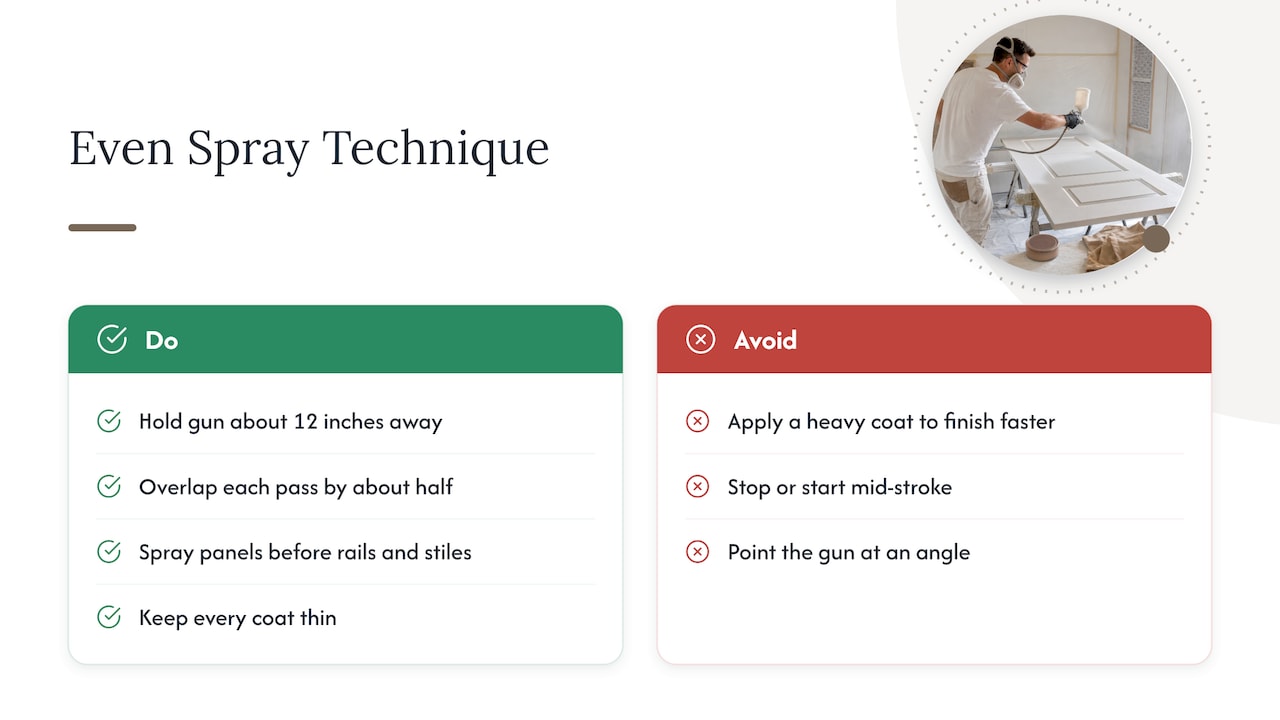
Where it goes wrong: stopping and starting mid-stroke, and pointing the gun at an angle. Even speed and distance are skills that come from spraying doors every week.
6. Recoat and cure
Two coats is the standard, and the manufacturer’s recoat window sets the timing. With the Behr enamel above, that is 4 to 8 hours between coats. Doors feel dry long before the film is hard, so give the final coat the cure time on the label before you rehang them and before the door touches its stop or a hand.
Where it goes wrong: rehanging too early. Prints, stuck door stops and chipped edges are nearly always a patience problem.
7. Rehang and touch up
Rehang each door on its own hinges, check the latch and clean the hardware. Our crews leave worksites spotless, so you get your rooms back clean.
Safety when spraying indoors
Spray painting creates mists and vapours, and the Canadian Centre for Occupational Health and Safety lists toxicity, fire and explosion, and compressed-air hazards. Its guidance is to read the label and safety data sheet (SDS) first, use an approved respirator, eye and face protection, gloves and coveralls, ventilate while spraying, ground equipment, remove ignition sources, and follow the applicable building, fire and occupational-safety rules.
In practice for a home:
- Wear a respirator rated for paint vapours and eye protection, not a basic dust mask.
- Create cross-ventilation that moves air out of the space, and keep children, pets and anyone sensitive to fumes out of the area.
- Switch off or shield pilot lights and other ignition sources, especially with solvent-based products. Water-based enamels reduce the fire risk.
- Never leave rags soaked with finish in a pile; follow the product’s SDS for disposal.
A professional crew arrives with the equipment and containment planned. That is a big reason spraying inside a home is better left to us than improvised with a rental sprayer in a hallway.
Where our spray work fits
Our Fine-Finish and Millwork Spraying service covers doors, trim, built-ins and similar millwork. If you want to know how we approach it, our article on millwork spraying in Toronto explains what to expect, and our page for fine-finish painters shows how it fits with a larger project. If your doors are wood and you prefer a natural tone, see interior door staining.
For condo boards, landlords and developers, the case for spraying is consistency: every door in the building gets the same sheen and the same durability, whether it is 20 doors or 200.
Spraying your doors with Sigma Painting
We paint homes, condos, offices and new builds across the GTA, and doors are often part of a larger interior repaint. You get a free, fixed, rapid estimate, a complimentary colour consultation, premium materials, thorough prep and cleanup, and a written workmanship warranty. Start with our interior painting service, or book your estimate and tell us how many doors you have and what they are made of.

For larger scopes such as new construction, multi-unit projects and commercial suites, we scope the whole job, doors included, under one contract.
Perspective
Doors are the most-touched painted surface in a home, and also the one people judge without knowing why. A hand-brushed door in the wrong paint looks a little tired within a year. A sprayed door in a proper trim enamel looks like it came from the factory and stays that way.
We think the finish is decided long before the sprayer starts: in the sanding, the filling, the primer, the masking and the patience between coats. That is the part clients do not see and the part we care about most. Our promise is a flawless finish and a stress-free job, so we take the doors off, protect the space, spray, and put everything back clean.
If you are choosing between brushing and spraying, think about how many doors you have, how smooth you want them and how soon you need the house back. When quality and consistency are the goal, spraying is what we recommend.
Enrico
FAQ
Can you spray paint interior doors without removing them?
Yes, but it takes complete masking of hinges, hardware and jambs, and it raises the risk of runs on vertical faces. Removing the doors and spraying them flat is the cleaner method and reduces masking and drips. For a premium result, doors come off.
How many coats do interior doors need?
Two coats is the standard for a durable trim enamel, with the label’s recoat time between them. Behr’s alkyd enamel, for example, lists 4 to 8 hours before recoating. Bare wood, stained or glossy doors need primer first.
How much does it cost to spray paint interior doors in Ontario?
One 2026 Ontario guide prices a sprayed door at $140 for two coats before HST, against $110 brushed. Door style, condition and quantity change the number, which is why we give a fixed estimate after we see the job.
What is the best paint for spraying interior doors?
A trim enamel made for doors, not wall paint. It cures harder and resists scuffs and sticking. Follow the label for tip size, filter and whether the paint can be thinned.
Sources
- Graco: How to Paint Trim & Doors Using a Sprayer
- Behr Canada: Alkyd Satin Enamel
- Builders Ontario: Cost to Paint Interior Doors, Baseboard and Trim in Ontario
- Canada Construction Network: Painting Costs Across Canada
- CCOHS: Spray Painting


