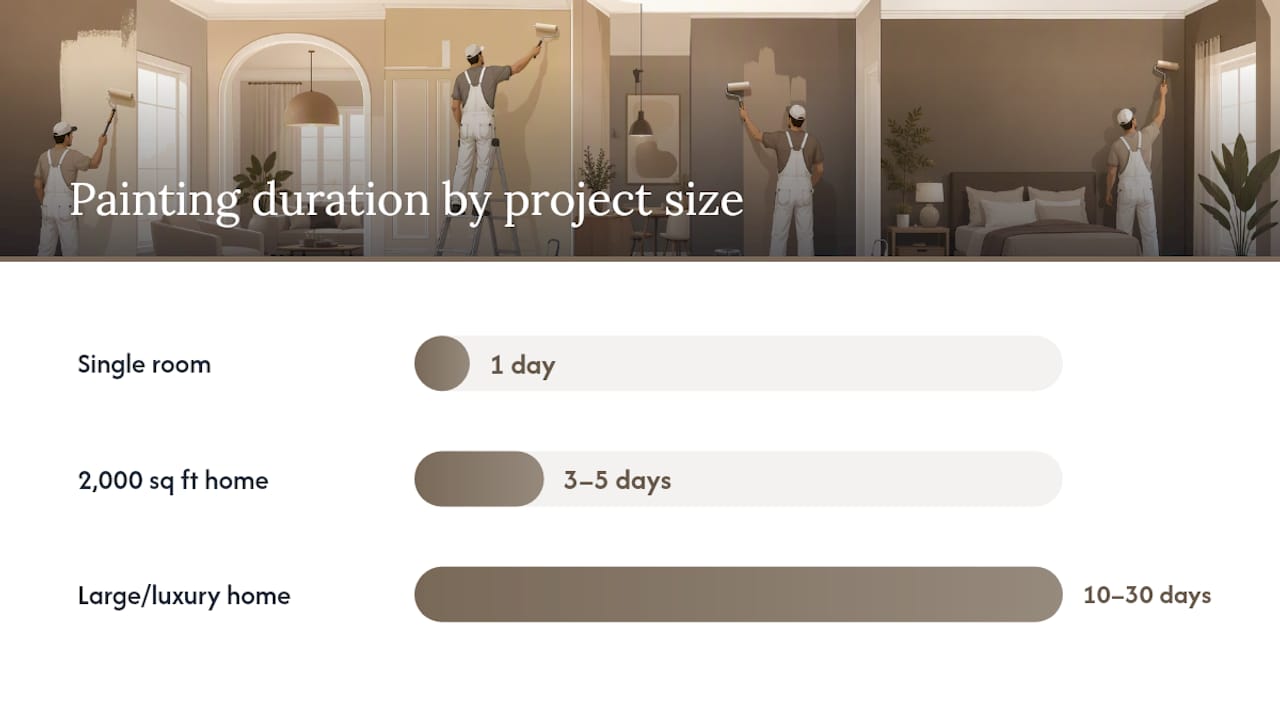
A single room takes 4 to 8 hours of active work for a two-person crew, or a full day once ceilings and trim are added. A whole home between roughly 1,500 and 2,500 square feet usually takes 3 to 5 working days with that same crew, with longer times for larger houses. The number that actually moves those ranges isn’t paint or crew speed. It’s how much prep the walls need and how long each coat has to dry before the next one goes on.
TL;DR:
- Professional crews typically paint one room in 4 to 6 hours, but prep, drying, and detailed work can extend this to a full day per room.
- Delays often occur from color changes, wallpaper removal, textured surfaces, or humidity, which can extend timelines by up to 50%.
- DIY painting usually takes two to three times longer than professional work due to workflow differences and skill levels.
- Proper scheduling and preparation, including early color confirmation and room clearing, are essential to avoid unexpected project extensions.
Table of Contents
- How Long Does Interior Painting Take Per Room and Whole Home?
- What Are the Stages of an Interior Painting Project?
- What Does a Day-by-Day Painting Schedule Look Like?
- What Slows Down an Interior Painting Project?
- Is DIY Painting Really Slower Than Hiring a Pro?
- How Do Painting Professionals Keep Projects on Schedule?
- A Field Note on Realistic Scheduling
- Get a Timeline You Can Actually Plan Around
- Sources
- FAQ
How Long Does Interior Painting Take Per Room and Whole Home?
Before a contractor ever walks through the door, you can build a rough planning window using averages from similar jobs. These numbers assume a two-person professional crew working standard drywall in fair condition, no major repairs, and one color change per room.
| Room | Pro crew (walls only) | DIY (solo) |
|---|---|---|
| Small bedroom | 2–3 hours | 6–9 hours |
| Master bedroom | 3–5 hours | 9–14 hours |
| Living room | 4–6 hours | 12 hours |
| Kitchen | 4–7 hours | 12–20 hours |
| Bathroom | 2–4 hours | 6–10 hours |
| Hallway | 2–4 hours | 5–9 hours |
Whole-home ranges scale with square footage and crew size. A 2,000 square foot home typically takes a professional crew 3 to 5 working days, while smaller and larger homes shift accordingly:
- 1,000 sq ft: 2 to 3 working days
- 1,500 sq ft: 3 to 4 working days
- 2,000 sq ft: 3 to 5 working days
- 2,500 sq ft: 4 to 7 working days
- 3,000+ sq ft: 7 to 9 working days, sometimes longer with heavy trim work
A “working day” here means active on-site labor, not calendar time. If a crew shows up Monday and finishes Wednesday, that’s three working days even if drying pushes the final walk-through to Thursday. Crew size matters too: these ranges assume two painters. Add a third and you compress the timeline; go solo and you’re looking at two to three times longer.
What Are the Stages of an Interior Painting Project?
Every interior job moves through the same basic phases, whether it’s one bedroom or a six-bedroom house. Knowing where the hours actually go helps you spot a realistic estimate from an inflated one.
- Consultation and estimate. A walkthrough usually takes 30 to 60 minutes; a written estimate typically follows within 1 to 3 business days.
- Prep work. Moving and covering furniture, patching holes, sanding rough spots, and caulking gaps run anywhere from 30 minutes for a tidy bedroom to a full first day on older homes with cracked plaster or years of nail holes.
- Priming. Needed for color changes, stains, or bare drywall. Active application is fast, but the recoat wait matters more than the labor.
- Paint coats. Most rooms get two coats. Active brushing and rolling for one coat in a standard bedroom runs 1.5 to 3 hours per coat.
- Trim, doors, and ceilings. Detail work often takes as long as the walls themselves, especially with multiple doors or crown molding.
- Cleanup and walk-through. Usually 30 to 60 minutes per room once the final coat has cured enough to inspect.
Latex paint dries to the touch in about an hour and becomes recoatable in 2 to 4 hours under standard indoor conditions of roughly 70°F and 50% humidity, according to Pilot Painting’s interior timeline breakdown. Push the humidity up or the temperature down, and that window stretches considerably, which is exactly why two identical rooms can take different amounts of time depending on the week you book them.
What Does a Day-by-Day Painting Schedule Look Like?
Seeing the hours laid out on a clock makes the abstract ranges above feel a lot more concrete. Here’s how a two-person crew typically structures three common project sizes.
Single room, one day:
- 8:00 to 9:00 AM: Furniture moved, surfaces covered, holes patched
- 9:00 to 11:00 AM: First coat on walls and ceiling
- 11:00 AM to 1:00 PM: Recoat window while crew preps trim and doors
- 1:00 to 3:00 PM: Second coat on walls
- 3:00 to 4:30 PM: Trim and door painting
- 4:30 to 5:00 PM: Cleanup and walk-through
2,000 sq ft home, 3 to 5 days: Crews rarely paint one room start to finish before moving on. Instead they prime an entire zone of rooms in sequence, then rotate back for second coats once the first rooms have dried. This overlap is why a professional crew finishes in days what a solo DIYer needs weeks for. Day 1 covers prep and priming across bedrooms; Day 2 handles first coats while trim gets cut in; Days 3 through 5 cover second coats, hallways, and detail work.
Large or luxury homes, 10 to 30 working days: Bigger properties add milestones. Custom trim, accent walls, multiple color zones, and staircases each extend the plan, and consultation, color selection, and scheduling can add another 4 to 12 weeks before the crew even picks up a brush.
What Slows Down an Interior Painting Project?
A few predictable factors account for almost every timeline that runs longer than expected, and most of them are avoidable with early planning.
- Color changes, especially dark to light, often need tinted primer and an extra coat, adding 30 to 50% more time to that room.
- Wallpaper removal and water-stain repairs can add a full day or more depending on how much of the wall is affected.
- Textured wall remediation (skim coating popcorn ceilings, for example) is one of the slowest prep tasks in the business.
- Humidity and cold temperatures extend recoat windows well beyond the standard 2 to 4 hours, which pushes multi-coat jobs into extra days during humid summer stretches or cold snaps.
- Living in the house during the project typically adds 10 to 20% more time because crews have to protect furniture and keep a bedroom and bathroom usable at all times.
Pro Tip: Confirm your paint colors at least a week before your start date. Last-minute color swaps are the single most common reason a “3-day job” turns into a 5-day job, since the crew has to reorder tinted paint and rework the sequencing.
Is DIY Painting Really Slower Than Hiring a Pro?
Yes, by a wide margin. DIY painting typically takes two to three times longer than a professional crew tackling the same rooms, mostly because one person can’t run the “zone” workflow pros use, priming one area while paint dries in another.
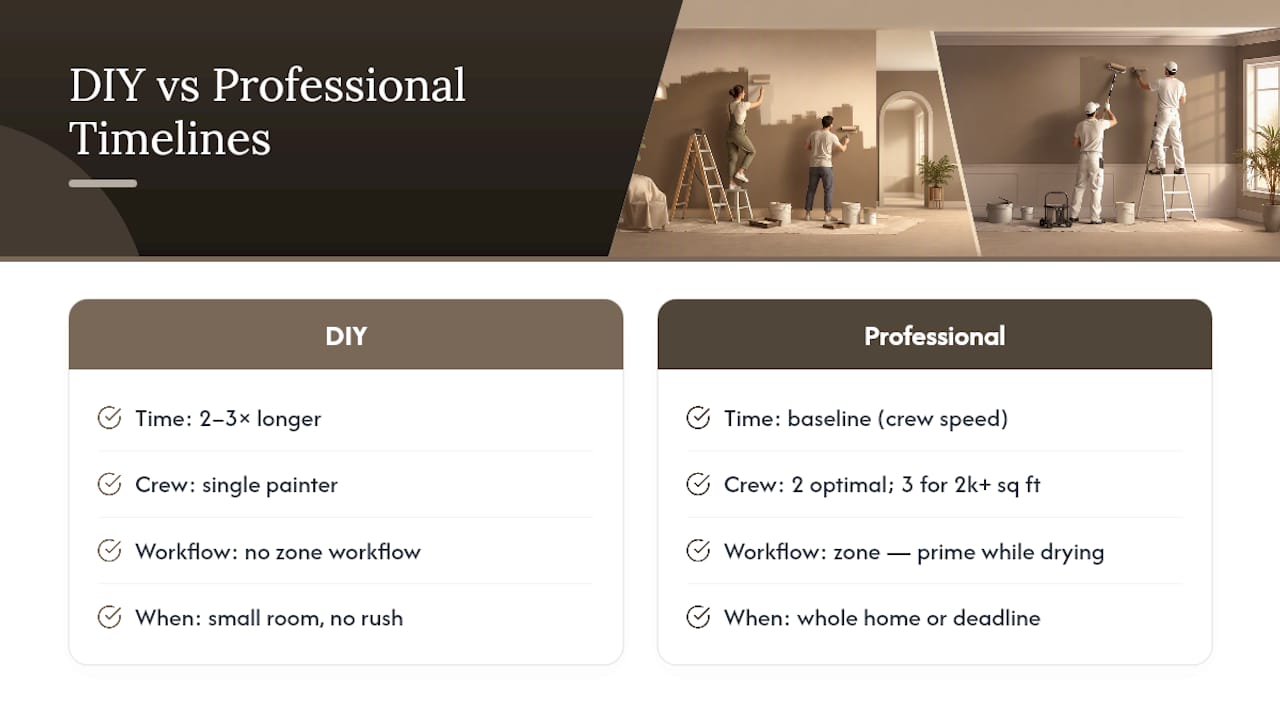
Crew size has its own sweet spot. Two painters cover most homes efficiently. A third painter speeds up anything 2,000 square feet or larger. Beyond four painters, crowding and lap-mark risk start working against you, since too many people finishing the same wall section at different speeds creates visible seams.
DIY makes sense for a single small room with light prep and no rush. Hire a professional crew when you’re covering a whole home, dealing with repairs, or working against a fixed move-in date.
How Do Painting Professionals Keep Projects on Schedule?
Contractors who consistently hit their deadlines rely on a handful of specific practices rather than luck. Sequencing is the biggest one: crews prep and prime an entire zone before circling back for second coats, so drying time in one room never leaves the whole crew idle.
Quality checks matter for the schedule too, not just the finish. A project manager who verifies tint batches and maps out color-coded room schedules prevents the late-day scramble that happens when a delivery arrives mis-tinted.
Homeowners influence the calendar more than most realize:
- Clearing rooms before crews arrive saves setup hours that otherwise eat into paint time.
- Confirming your color mapping before day one avoids mid-project reordering.
- Securing pets away from work zones keeps doors and windows open for ventilation and faster drying.
A Field Note on Realistic Scheduling
The surprise that trips up almost every homeowner isn’t the painting itself, it’s the drying. People book a “one-day” room and forget the recoat window eats a chunk of the afternoon. Build that wait into your calendar before the crew shows up, not after.
— Enrico
Get a Timeline You Can Actually Plan Around
Generic online calculators can’t account for your home’s prep needs, your color choices, or how many rooms need to stay usable while work is underway. Quotes are built around an on-site walkthrough, a project management process, and use of premium materials chosen to hit standard recoat windows instead of fighting them.

That combination is what keeps a quoted 4-day job from quietly becoming a 7-day job: tint batches get verified before the crew arrives, rooms get sequenced in zones, and your schedule gets built around your actual move-in or event date rather than a generic average. If you’re planning a project and need a realistic calendar instead of a guess, request a free consultation through Sigma Painting’s interior painting services page. Have your target start date, room count, and any color changes ready when you call. It speeds up the estimate and locks in a schedule you can actually build around.
Sources
- How Long Does Interior Painting Take? A Real Timeline for Berryville Homeowners - Pilot Painting LLC
- How Long Does It Take to Paint a House Interior? | Paint Pro NE
- How Long to Paint a Room? Realistic Time Estimates - PaintPricing
- Whole-Home Interior Painting Timeline: Complete Planning Guide (2026) | D&D Pro Painting
FAQ
What Is the 80/20 Rule in Painting?
Rooms that skip proper prep tend to need rework later, which erases any time saved upfront.
In What Order Should You Paint the Inside of a House?
Most pros paint ceilings first, then walls, then trim and doors last, working room by room or in zones so earlier areas can dry while later ones get primed. This sequencing is also why professional crews finish whole homes faster than solo DIY painters working one room start to finish.
Is Fall Too Late to Paint the Inside of a House?
No. Interior painting isn’t weather-dependent the way exterior work is, since indoor temperature and humidity stay controllable year-round. Cooler, drier fall air can actually shorten recoat windows compared to a humid summer stretch.
Do You Really Need to Wait 4 Hours Between Coats of Paint?
Not always. Latex paint is typically recoatable in 2 to 4 hours at standard indoor temperature and humidity, but colder or more humid rooms can push that window longer. Waiting the full recommended time prevents lifting and streaking in the second coat.
How Long Before I Can Move Furniture Back Into a Painted Room?
Most painted rooms are safe for light use in 24 to 72 hours, but full cure for latex paint takes 14 to 30 days. Avoid leaning furniture directly against walls or hanging heavy pictures until that full cure window passes.