

A professional crew of 2–3 painters typically finishes a whole-house interior repaint in 3–8 working days and a typical exterior in 3–6 working days. Solo DIYers should budget roughly double that on both counts. Here’s how those numbers break down by project type:
- Single room: 5–6 hours (pro crew); 1–2 days (solo DIY)
- Small whole interior (1,000–1,500 sq ft): 3–4 working days (2–3 painters); 8–10 days (solo)
- Average interior (1,500–2,500 sq ft): 5–7 working days (2–3 painters); 12+ days (solo)
- Exterior, single-story: 3–5 working days (pro crew); 1–2 weeks (DIY)
- Exterior, two-story: 5–10 working days (pro crew); 2–3 weeks (DIY)
- Calendar multiplier: Add 30–40% for weekends, drying windows, and weather delays
Verdict: Hire pros when you’re on a tight timeline, painting above one story, or dealing with heavy prep. DIY works for small rooms and tight budgets — just plan for at least twice the working days.
Key Takeaways
A professional crew of 2–3 painters typically completes a whole-house interior in 3–8 working days and a typical exterior in 3–6 working days, while solo DIYers should plan for at least double that on both.
| Point | Details |
|---|---|
| Interior timelines | A 2–3 painter crew finishes most interiors in 3–8 working days; a 2,000 sq ft home runs 70–90 total labor hours. |
| Exterior timelines | Pro crews finish typical single-family exteriors in 3–6 working days; DIYers should plan 1–2 weeks minimum. |
| Prep dominates exterior jobs | Prep work often consumes half the total time on older or weathered houses; never leave bare surfaces unprimed overnight. |
| Weather buffer required | Weather delays add roughly 20–30% to exterior calendar time; aim for 3–5 consecutive rain-free days before and after painting. |
| Sigma Painting | Sigma Painting’s GTA crews handle scheduling, prep, and execution in a compressed timeline with a pre-project condition assessment. |
Table of Contents
- How long does it take to paint a house? Timelines by project type
- Seven factors that change how long painting actually takes
- Drying times, safe re-entry, and how to fold them into your schedule
- Sample day-by-day schedules you can copy into your calendar
- Solo painter vs. crew: the math that helps you decide
- What the research says about weather, seasons, and exterior scheduling
- How to finish faster without sacrificing quality
- What experienced painters know that most homeowners don’t
- Sigma Painting: professional scheduling without the guesswork
- Sources
How long does it take to paint a house? Timelines by project type
The table below uses two-coat coverage, standard 8–9 ft ceilings, normal prep conditions, and a 2–3 painter crew for professional estimates. DIY figures assume one person working full days.
| Project Type | Pro Crew (working days) | Solo DIY (working days) |
|---|---|---|
| Single room (12×12 ft) | 1 | 1–2 |
| Small interior (1,000–1,500 sq ft) | 3–4 | 8–10 |
| Average interior (1,500–2,500 sq ft) | 5–7 | 12–13 |
| Large interior (2,500+ sq ft) | 7–10 | 12+ |
| Exterior, small 1-story | 2–3 | 5–7 |
| Exterior, average 1-story | 3–5 | 7–10 |
| Exterior, 2-story | 5–8 | 10–12 |
| Large or complex exterior | 8–12 | 14–20 |
A 2,000 sq ft interior repaint maps to roughly 70–90 total labor hours across prep, priming, two coats, and trim. Divide by crew size to get working days.
Working days vs. calendar days: A 5-day working schedule easily stretches to 8–10 calendar days once you account for weekends, overnight drying between coats, and any weather holds on exterior work. Budget calendar time generously, especially if you’re planning around family schedules or a contractor’s availability window.
Seven factors that change how long painting actually takes
No two houses paint in the same time. These are the variables that shift estimates up or down the most.
- Crew size and productivity. A 2-painter crew moves roughly twice as fast as one person up to about 4 painters. Beyond that, coordination overhead eats into the gains. Most residential pros deploy 2–4 painters for exactly this reason.
- Surface prep condition. Fresh drywall or recently painted surfaces need minimal prep. An older exterior with peeling paint, wood rot, or failing caulk can easily double the total job time. Prep work alone often consumes half the total time on weathered houses.
- Number of coats and color changes. Two coats is standard. Switching from a dark color to a light one (or vice versa) often requires a tinted primer coat, adding a full day or more to the schedule.
- Primer needs. New drywall, bare wood, and stain-blocking situations all require primer before topcoats. Factor in drying time between primer and paint.
- Paint type. Latex (water-based) dries to recoat in 2–4 hours under good conditions. Oil-based paint needs up to 24 hours between coats. An oil-based job on a whole interior can add 2–3 calendar days to the schedule compared to latex.
- Architectural complexity. High ceilings, staircases, detailed trim, arched windows, and cathedral rooms all slow production. A 2,000 sq ft home with vaulted ceilings takes meaningfully longer than a 2,000 sq ft ranch with flat 8-foot ceilings.
- Occupancy and access. Painting around furniture, pets, and daily household routines adds roughly 10–20% to calendar time. Moving furniture, protecting floors, and working around nap schedules or work-from-home setups all chip away at productive hours.
Pro Tip: The single most common schedule killer on exterior jobs is leaving a surface partially prepped — scraped but not yet primed — overnight. If rain or high humidity hits before you seal that surface, you may need to redo the prep. Professionals aim to complete sealing and priming as quickly as possible to avoid this exact problem.
Drying times, safe re-entry, and how to fold them into your schedule
Drying time is not just a technical detail. It directly controls how many calendar days a project takes.
Latex paint (water-based):
- Touch dry: 1–2 hours
- Safe to recoat: 2–4 hours under normal conditions (65–75°F, below 50% humidity)
- Full cure: 2–4 weeks (the paint hardens gradually after it dries)
Oil-based paint:
- Touch dry: 6–8 hours
- Safe to recoat: 16–24 hours
- Full cure: 3–7 days minimum
High humidity slows both types significantly. Cold temperatures (below 50°F) slow drying further and can cause adhesion problems.
When can you sleep in a freshly painted room? Most latex paints are safe to sleep near after 24–48 hours with good ventilation. Low-VOC and zero-VOC formulas shorten that window. Open windows, run fans, and keep the room ventilated for at least 2–3 days. Households with infants, pregnant members, or respiratory sensitivities should wait the full 3 days and prioritize low-VOC products.
Folding drying into your calendar: A 3-day working schedule for a small interior often becomes 5–7 calendar days once you account for overnight drying between coats, a day off mid-project, and a final ventilation period before moving furniture back. Build that buffer in from the start rather than discovering it mid-project.
Sample day-by-day schedules you can copy into your calendar
1. Single room (1 working day)
- Morning: Move furniture, tape trim, lay drop cloths, patch holes, sand, wipe dust
- Midday: Apply primer if needed; let dry 1–2 hours
- Afternoon: First coat of paint; let dry 2–4 hours
- Late afternoon: Second coat; clean brushes and rollers
- Contingency: If you find significant wall damage, add half a day for repairs and a full drying window before painting
2. Small whole-house interior (3–5 working days)
- Day 1: Full prep — move furniture, protect floors, patch and sand all rooms, tape trim throughout
- Day 2: Prime all surfaces needing it; first coat on ceilings
- Day 3: First coat on walls throughout; let dry overnight
- Day 4: Second coat on walls; first coat on trim and doors
- Day 5: Second coat on trim; touch-ups; remove tape; clean up
- Contingency: Add 1 day if you discover a color change requiring extra primer coats
3. Average two-story exterior (7–12 calendar days)
- Days 1–2: Power wash, scrape, sand, caulk, repair any rot or damaged siding
- Day 3: Prime bare wood and repaired areas; inspect and re-caulk as needed
- Days 4–5: First coat on siding (body color); let cure overnight
- Days 6–7: Second coat on siding; first coat on trim
- Day 8: Second coat on trim; doors and accent details
- Day 9: Touch-ups and final inspection
- Days 10–12: Weather buffer. Plan for weather delays adding roughly 20–30% to exterior calendar time, so build those days in before you need them
- Contingency: If rot is found under trim on Day 1, add 2–3 days for repair and drying before priming
4. Heavy-prep exterior (2+ weeks)
Older homes with failing paint, wood rot, or multiple previous paint layers need a dedicated prep phase before any coating goes on. Budget 3–5 days of prep alone, then follow the two-story schedule above. Leaving bare or partially prepped surfaces exposed between work sessions risks rework if weather turns. On a heavy-prep job, aim to prime every section the same day it’s scraped and sanded.
Solo painter vs. crew: the math that helps you decide
A 2,000 sq ft interior takes roughly 70–90 labor hours from start to finish. Here’s how that translates by crew size:
- 1 painter: about two weeks of working days
- 2-painter crew: about a week of working days
- 3-painter crew: somewhat less than a week
- 4-painter crew: a few working days (diminishing returns begin here)
Crew productivity scales roughly linearly up to about 4 painters on a residential job. After that, coordination costs — who’s painting which room, who’s moving the ladder, who’s waiting on a drying section — reduce per-person output. That’s why most professional residential crews run 2–4 painters, not 6 or 8.
When to hire professionals:
- Timeline under 2 weeks for a whole house
- Any work above one story (safety and equipment)
- Heavy prep: rot, failing paint, or multiple layers to strip
- Complex trim, detailed millwork, or high ceilings
- You want a warranty on the finish
When DIY makes sense:
- One or two rooms with straightforward walls
- Budget is the primary constraint and you have time
- You have painting experience and the right tools already
For a realistic contractor comparison, the homeowner’s checklist for choosing a painting contractor walks through what to ask about crew size, scheduling, and prep practices before signing anything.
What the research says about weather, seasons, and exterior scheduling
Exterior painting is weather-dependent in ways interior work simply isn’t. Getting the timing wrong doesn’t just slow the job — it can shorten the life of the finish by years.
Industry guidance from Angi points to late spring through early fall as the ideal exterior painting window in most U.S. markets. The practical temperature range for most latex exterior paints is 50–85°F; oil-based formulas tolerate slightly wider ranges but still fail below 40°F.
Building a rain-free buffer: Most trade sources recommend scheduling exterior painting when you have at least 3–5 consecutive dry days ahead. Paint applied before rain fully cures can blister, peel, or wash off entirely.
Seasonal considerations by U.S. region:
- Northeast and Midwest: May through September is the reliable window; avoid October and April when temperature swings are unpredictable
- Southeast: Spring and fall are ideal; summer humidity often pushes above the 85% threshold
- Southwest: Spring and fall work well; summer heat can cause paint to dry too fast, trapping solvents
- Pacific Northwest: Summer is the only reliable window; the rest of the year carries too much rain risk
For a deeper look at how temperature affects adhesion and drying behavior specifically, the exterior painting temperature guide covers the science behind why those thresholds matter.
How to finish faster without sacrificing quality
Speed and quality aren’t opposites — but they require deliberate choices about tools, sequencing, and prep.
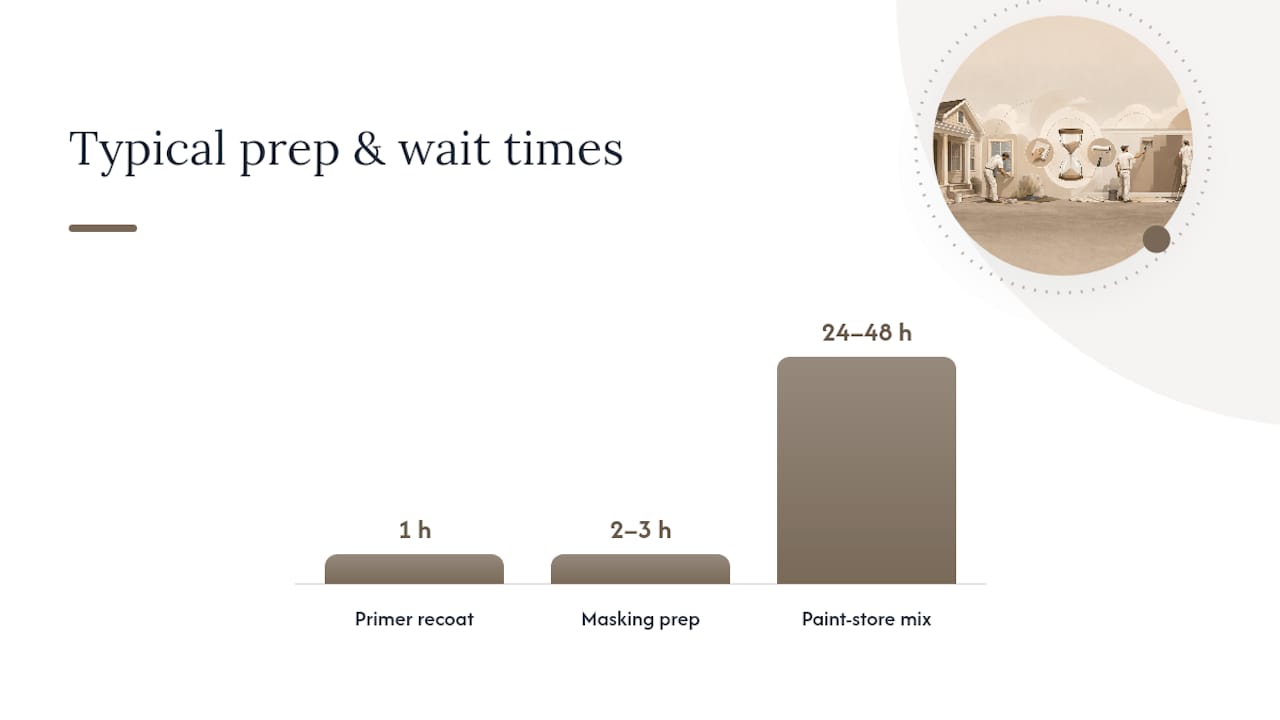
- Rent an airless sprayer for large exteriors. A sprayer covers siding 3–4 times faster than a brush and roller. The tradeoff: masking windows, doors, and landscaping takes 2–3 hours upfront. Worth it on any exterior over 1,500 sq ft of paintable surface; less worthwhile for a single-story with lots of trim detail.
- Overlap prep and painting. On multi-day exterior jobs, have one person prepping the next section while another paints the section just finished. This parallel workflow can cut total calendar time by 20–30%.
- Pre-order materials and colors. Custom-mixed colors sometimes require 24–48 hours at the paint store. Ordering a week ahead eliminates a common Day 1 delay.
- Use quick-dry primer where appropriate. Many water-based primers are recoatable in 1 hour. On a tight schedule, that’s the difference between priming and painting the same day versus waiting until tomorrow.
- Sequence rooms strategically. Paint ceilings first, then walls, then trim. Work from the room farthest from the exit toward the door so you’re never painting yourself into a corner or walking through wet paint.
- Coordinate with other trades early. If an electrician is installing new fixtures or a carpenter is replacing trim, those trades need to finish before painting starts. A one-day delay from a late trade can cascade into a 3-day schedule slip if it falls on a Friday.
Pro Tip: A sprayer is fastest on open, flat siding — lap siding, stucco, or smooth board. On Victorian-era homes with intricate brackets, corbels, and spindles, brush-and-roll often beats a sprayer once you account for the masking time and overspray cleanup. Match the tool to the surface, not the other way around.
For context on how painting duration connects to exterior painting cost, longer prep phases and complex architecture are the two biggest drivers of labor cost — which is exactly why getting an accurate scope upfront matters.
What experienced painters know that most homeowners don’t
Most scheduling surprises on a painting project aren’t random. They’re predictable — if you know where to look.
The biggest one is hidden rot. On exterior jobs, you often don’t know it’s there until you start scraping. A trim board that looks solid from the ground can be soft underneath the paint film. Finding rot on Day 1 of a planned 5-day job means stopping, sourcing materials, doing carpentry repairs, waiting for filler or new wood to dry, and then repriming before you can paint. That’s a 2–3 day addition that no estimate accounts for unless the contractor has physically inspected every surface.
High humidity is the other silent schedule killer. A job planned for 6 days can stretch to 9 without a single drop of rain falling. Professionals who work in humid climates build this into their scheduling automatically. Homeowners usually don’t, and they end up rushing a second coat onto a surface that isn’t ready.
The fix for both problems is the same: inspect thoroughly before committing to dates, and build a contingency buffer of at least 2 days into any exterior schedule. Sigma Painting’s process includes a detailed pre-project assessment precisely to surface these issues before work begins, not after. For readers weighing whether to repaint now or wait, the signs it’s time to repaint your exterior guide covers the condition indicators that affect both timing and prep scope.
Sigma Painting: professional scheduling without the guesswork

Knowing how long a project takes is one thing. Fitting it into your life — around work schedules, kids, pets, and weather — is another problem entirely. Sigma Painting handles the scheduling complexity for you: a dedicated crew arrives with all materials, completes prep and painting in a compressed, efficient timeline, and leaves the space clean and ready to use. No half-finished walls sitting through a rainy weekend. No second-guessing whether the surface is dry enough.
For homeowners in the GTA ready to move from planning to booking, the instant quote calculator gives you a project estimate and available start dates in minutes. Or browse interior painting services and exterior painting services to see what a full-service project looks like from first coat to final walkthrough.
Sources
- Angi: Best time to paint a house
- PaintPricing: How long to paint a house
- GharPedia: Exterior house painting timing and prep
Recommended
- Cabinet Painting vs Replacement — GTA Homeowner’s Guide | Sigma Painting
- 5 Signs It’s Time to Repaint Your Exterior — GTA Painter’s Guide | Sigma Painting
- Exterior Painting Cost: A Homeowner’s 2026 Budget Guide | Sigma Painting
- How to Choose a Painting Contractor: A Homeowner’s Checklist | Sigma Painting


