
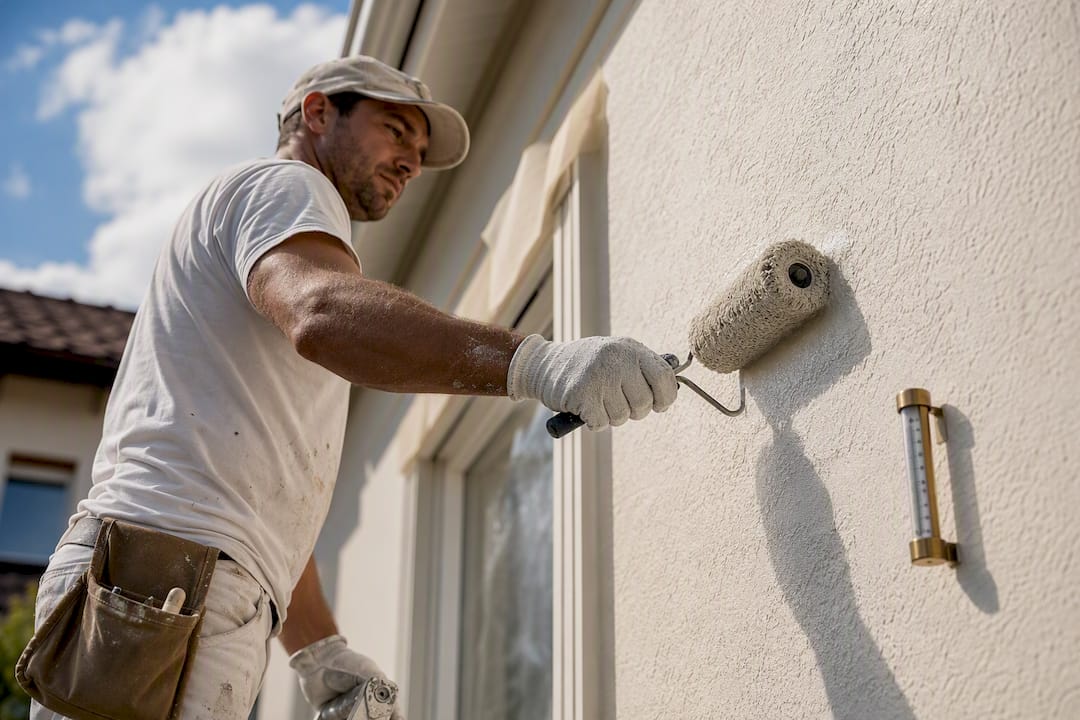
Spring through early fall gives you the widest run of paintable days, with the practical sweet spot landing between the mid 50s and mid 70s°F. But the calendar only gets you in the door. The job itself hinges on three rules: stay inside the paint’s labeled temperature range, get a rain free window for the full dry time, and keep the surface warmer than the dew point. Meet all three and any day in that season may be suitable. Missing one suggests waiting or consulting a professional who can monitor weather conditions closely.
TL;DR:
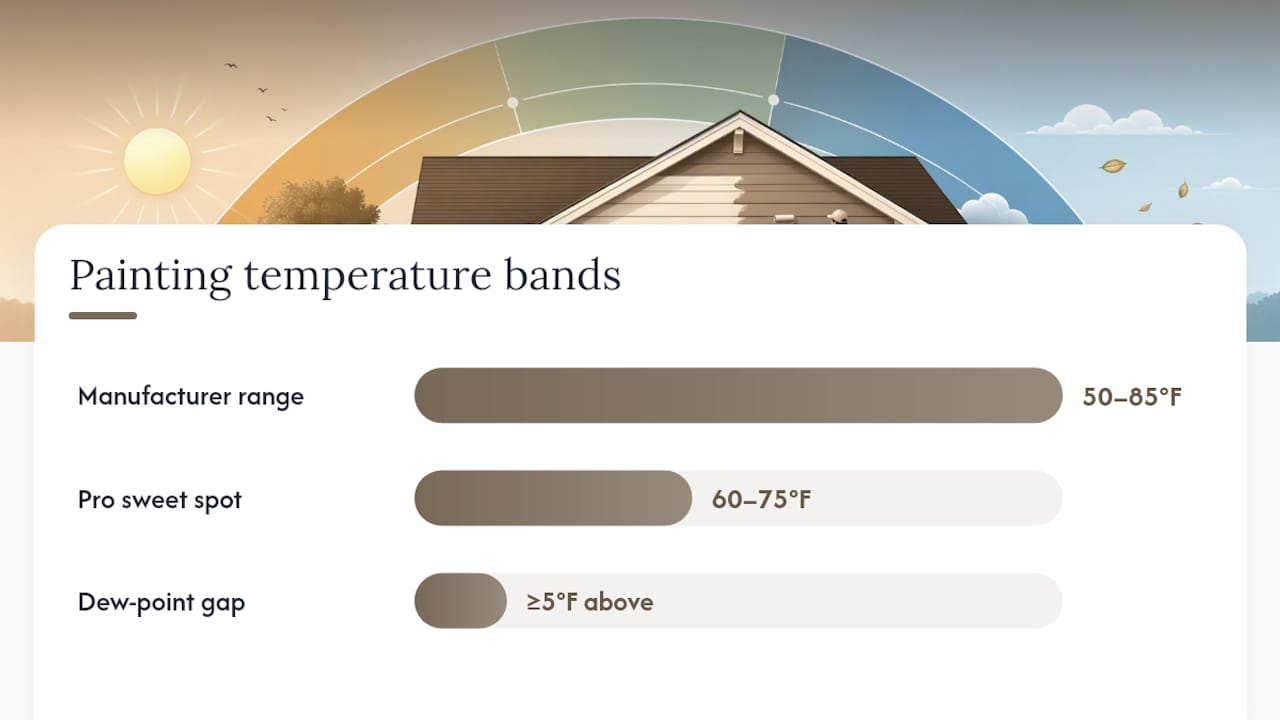
- Temperatures should stay within the paint’s labeled range, ideally 60 to 75°F, with overnight lows also considered for successful application.
- Surface temperature must be at least 5°F above the dew point and rising, which is critical for proper curing and avoiding issues like blistering or lap marks.
- May, June, September, and October typically offer the most stable weather for exterior painting, but local conditions and paint labels take precedence.
- Rain-free periods of at least four to six hours are necessary, with 24 to 48 hours preferred for a durable cure, especially in humid or cool conditions.
- Weather conditions should be monitored hourly using forecasts and surface readings, as daily averages can mask marginal days that risk paint failure.
Table of Contents
- What Weather Conditions Determine the Best Time to Paint Exterior Surfaces?
- Which Months Give You the Best Season for Exterior Paint?
- What Is the Best Time of Day to Paint a House Exterior?
- Do Product Labels Override Seasonal Painting Rules?
- How Do You Handle Marginal Days and Rain Interruptions?
- Why Weather Management Separates a Good Paint Job From a Bad One
- Ready to Schedule Your Exterior Paint Job?
- Sources
What Weather Conditions Determine the Best Time to Paint Exterior Surfaces?
Six variables decide whether a day is a “go.” Get them all in range and the paint levels, cures, and bonds the way the manufacturer intended. Get even one wrong and you risk lap marks, blistering, or a finish that never fully hardens.
- Air temperature: Latex labels typically allow 50 to 85°F, but most pros treat 60 to 75°F as the real sweet spot for flow and cure. Watch the overnight low too, not just the daytime high.
- Surface temperature vs. dew point: The substrate needs to sit at least 5°F above the dew point and be rising, not falling, when you apply the coat.
- Humidity: Aim for moderate relative humidity levels. Higher humidity tends to extend dry time and increases the risk of condensation issues.
- Rain and dry window: You need a stretch of dry weather with nothing in the forecast until the coat sets.
- Wind: A light breeze helps the paint dry evenly. Strong gusts kick up dust and can flash dry the surface before it levels.
- Sun exposure on the surface: Direct hot sun on dark siding can push surface temperature far above air temperature, so shaded elevations should go first.
Statistic Callout: Manufacturer data commonly puts the acceptable latex application band at 50 to 85°F, but contractors narrow that to 60 to 75°F because paint applied at the extremes of its labeled range tends to skin over unevenly or dry too slowly to level out.
Pro Tip: Weigh all six variables together instead of checking them one at a time. A go/caution/no-go matrix that scores temperature, humidity, wind, sun, and rain probability side by side catches the marginal days a single reading would miss.
Which Months Give You the Best Season for Exterior Paint?
Spring and early fall win out for a simple reason: temperatures stay stable and humidity tends to sit in the moderate range that latex and acrylic paints prefer. Mid-summer heat can push surface temperatures well past the label’s ceiling by early afternoon, and the shoulder months of late fall and early spring bring cold overnight lows that slow curing to a crawl or stop it outright.
Here’s a conservative, generalized window for temperate climates. Local weather always overrides a calendar.
- March and April: Often too cold overnight; treat as a “watch the forecast” stretch rather than a default go.
- May and June: Frequently ideal. Humidity is dropping and daytime highs sit in the target range.
- July and August: Workable, but plan around midday heat by starting early and shifting to shaded elevations by afternoon.
- September and October: Often the most reliable stretch in many regions, with humidity down and overnight lows still holding above freezing.
- November onward: Generally too cold for most latex products without specialty formulations.
Because May, June, September, and October carry the lowest weather risk, they’re also when painting crews book up fastest. If you’re planning a multi-day exterior job, request an estimate several weeks ahead so your crew can lock in a stretch of dry weather rather than squeezing your project between rain delays.
What Is the Best Time of Day to Paint a House Exterior?
Morning dew needs to burn off before you start, which usually means waiting until mid-morning. From there you have a window that runs into mid-afternoon before you should stop, giving the film time to set before evening temperatures drop and humidity climbs again.
- Start once dew has evaporated from the surface, not just off the grass; learn about energy-efficient exterior choices for desert homes that influence surface temperature and paint timing.
- Work shaded or east-facing elevations early, then move to sun-exposed walls as the sun shifts, avoiding direct hot sun on any one wall for too long.
- Use an hourly forecast, an infrared thermometer for surface readings, and a dew-point calculator to confirm conditions before each elevation, not just once at the start of the day.
- Stop at least two hours before the surface temperature is projected to drop near the dew point or before sunset on any day that feels marginal.
Pro Tip: An infrared thermometer reads the actual siding surface, not the air. On a sunny day, dark siding can run 20 degrees hotter than the forecast high, which is exactly when flash drying and lap marks show up.
Do Product Labels Override Seasonal Painting Rules?
Yes. The Technical Data Sheet on your paint can is the final word on minimum and maximum application temperature, recoat time, and dew-point guidance. It overrides any general seasonal rule of thumb, and This check is performed before every exterior job regardless of what the calendar says.
- Check the label’s minimum and maximum temperature range and recoat window before buying or starting.
- Power wash siding, let it fully dry, and treat any mildew. That single step often adds a day to your schedule before you even open a can.
- Know your chemistry: latex and acrylic tolerate a wider temperature range than alkyd or oil-based products, which typically need warmer, more stable conditions to cure properly.
- Store and warm paint as the label instructs. Cold paint straight from a garage can be too thick to apply evenly even on a warm day.
Surface prep questions come up constantly, and power washing before painting is worth reading in full if your siding hasn’t been cleaned in a few years.
How Do You Handle Marginal Days and Rain Interruptions?
Give any coat at least four to six hours of dry weather to resist washoff, but 24 to 48 hours is the safer target for a fully durable cure, especially in cooler or more humid conditions.
- If rain starts mid-job, stop applying immediately and protect any wet edges you can reach.
- Let the surface dry completely, not just look dry, before resuming, since trapped moisture under a fresh coat causes blistering.
- Decide whether to adapt (switch elevations, shift your hours) or postpone entirely, based on which specific variable is out of range.
- Check the manufacturer’s recoat and adhesion guidance before applying a second coat after any weather delay.
Statistic Callout: A rain-free window of just four to six hours protects against washoff, but doubling or tripling that time to 24 to 48 hours gives the film the depth of cure that actually holds up through a Canadian winter.
For a deeper look at scheduling around unpredictable forecasts, how weather delays painting projects breaks down how crews plan buffer days into a contract.
Why Weather Management Separates a Good Paint Job From a Bad One
Homeowners tend to make the same mistake twice: they check the daytime high, see a nice number, and ignore the overnight low or the dew point entirely. That’s how a coat applied at 2 p.m. ends up hazy by 8 p.m. Multi-day exterior jobs are sequenced around hourly forecasts, not daily ones, moving crews between elevations as sun and shade shift. For large homes, tight weather windows, or any job where a warranty is on the line, hiring a pro who tracks these variables in real time is worth more than any calendar rule.
— Enrico
Ready to Schedule Your Exterior Paint Job?
Homeowners lose more paint jobs to bad timing than bad technique. Crews plan around hourly forecasts, not just the season, so your project starts when conditions actually support a lasting finish, not just when it’s convenient.

When you request an estimate, expect a walk-through of your siding’s condition, a discussion of prep needs like power washing or mildew treatment, and a proposed start window built around the current forecast rather than a fixed date. That’s the difference between a crew that shows up regardless of conditions and one that protects your investment by waiting for the right day. If your home needs a repaint this season, get in touch through Sigma Painting’s exterior painting services page and ask about weather-aware scheduling for your address.
Sources
- When Is the Best Time to Paint the Exterior of a House? — The Spruce
- Optimal Temperature to Paint Outside and Inside — Benjamin Moore
- Best Temperature to Paint Outside: 50-85°F Rule (2026) — Facade Colorizer
- Best Weather Conditions for Exterior Painting: Go or No-Go — PaintPricing


