
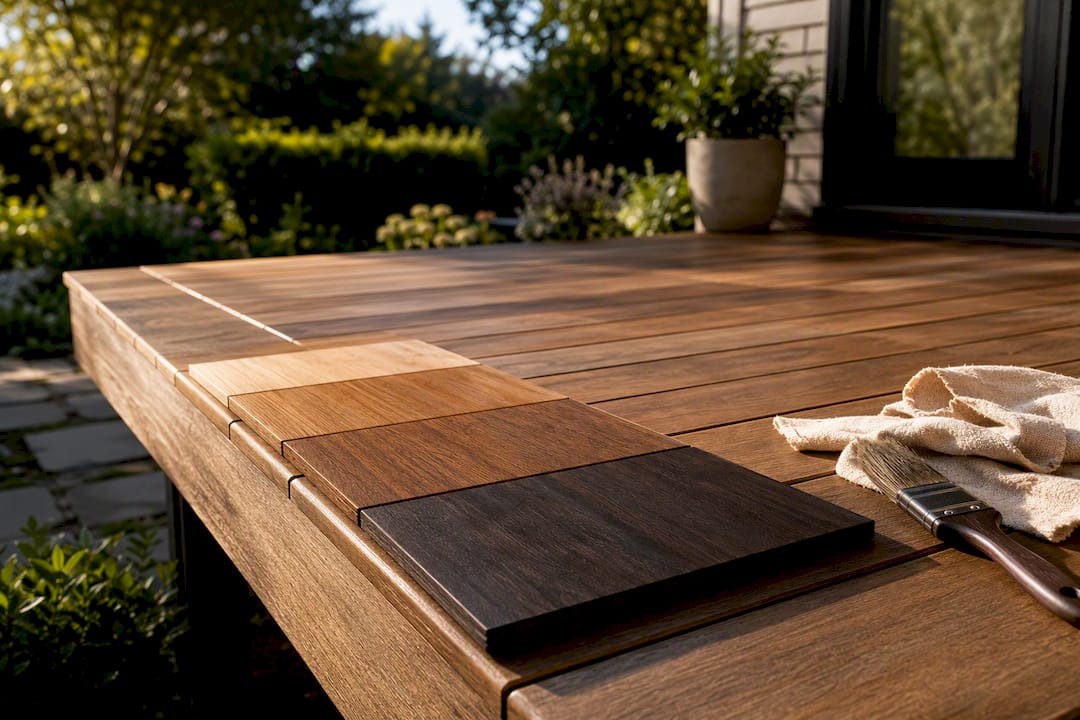
Pick opacity by your deck’s condition first, then choose a color that matches your house undertone and runs one to three shades darker. New or lightly weathered wood can handle a transparent or semi-transparent finish that shows the grain. Older, uneven boards need semi-solid or solid coverage to hide flaws. Once opacity is set, consider warm browns, driftwood grays, or deep charcoal, then confirm the pick with a test board before committing.
TL;DR:
- Choosing the right opacity is critical, with transparent or semi-transparent stains suited for new or lightly weathered wood, and solid stains best for older, heavily damaged decks.
- Warm brown tones and driftwood gray shades remain popular in 2026, with warm earthy hues being versatile across various siding and landscaping.
- Matching your deck stain to your house’s undertone, rather than exact hue, ensures a cohesive exterior, by selecting colors in the same temperature family that are one to three shades darker than your siding.
- Testing stain color on actual boards at different times of day prevents unexpected results caused by lighting changes or existing deck finishes.
- Professional consultation from Sigma Painting can simplify the process by providing surface assessments, sample boards, and customized color and opacity recommendations.
Table of Contents
- Deck Stain Colors Start With Opacity, Not the Chip
- Popular Color Families and How They Shift by Opacity
- Match Your Deck Stain Color to Your House’s Undertone
- How Wood Species and Condition Change the Final Color
- Test Your Deck Stain Color Before Committing to the Whole Deck
- Prep, Recoating, and the Heat Factor
- Field Notes: What Sigma Painting Sees on Real Decks
- Deck Stain Trends and What They Do for Resale Value
- Why the Same Deck Stain Color Looks Different by the Hour
- Coordinating Deck Stain With Furniture and Landscaping
- Why Opacity Discipline Beats Chasing a Trendy Palette
- Let Sigma Painting Handle the Color Decisions and the Labor
- Where to Verify Colors and Product Details
- Sources
- FAQ
Deck Stain Colors Start With Opacity, Not the Chip
Opacity decides how much wood grain shows through and how often you’ll be back on your knees with a brush. Transparent stains let the grain show almost completely but need frequent renewal. Semi-transparent stains hold up for a few years and still show the wood’s character. Semi-solid stains mask more of the surface while adding some grain visibility, typically lasting 3 to 4 years. Solid stains behave more like paint, hiding grain and imperfections for around 4 to 5 years, according to testing from BobVila.
Color reads differently at each opacity level on the same board. A honey brown at transparent strength looks warm and translucent; the same color at solid strength looks flat and almost like a factory finish. Moving from a lighter opacity to a heavier one later is simple. Going the other direction usually means sanding or stripping, so when a deck’s condition falls between two categories, the lighter option preserves more choices down the road, per field notes from Carolina Renew.
- New or lightly weathered decks (cedar, redwood, fresh pressure-treated lumber): transparent or semi-transparent.
- Decks with moderate graying or minor stains: semi-solid.
- Older decks with cracking, deep discoloration, or patch repairs: solid.
Popular Color Families and How They Shift by Opacity
Warm wood tones dominate for a reason. Cedar, redwood, chestnut, and honey shades flatter almost any softwood deck, and they photograph best at transparent to semi-solid opacity, where the underlying grain still peeks through. Push one of these into a heavy solid finish and it can start looking muddy rather than rich.
Driftwood and warmed gray tones have become the default “modern deck stain color” for good reason. A gray with a brown or taupe undertone reads as soft and current; a flat blue gray reads as cold and can clash with brick or warm-toned siding. This is one of the biggest shifts in 2026 color trends, which show warm earthy tones and taupe grays have been gaining ground over cooler, flatter palettes.
Deep charcoal and near-black stains show up more on contemporary builds with clean lines and metal railings. They look sharp in photos, but they absorb heat aggressively in direct sun, which matters more than most homeowners expect on a deck used barefoot in July.
- Warm browns (cedar, chestnut, honey): best at transparent to semi-solid.
- Driftwood/warmed grays: versatile at nearly every opacity.
- Charcoal/near-black: striking at semi-solid to solid, but hot underfoot.
- Muted blue or green tones: can look artificial unless the house has strong cool-toned trim to match.
Match Your Deck Stain Color to Your House’s Undertone
Matching undertone matters more than matching the exact hue. A deck stain doesn’t need to be the same color as your siding. It needs to share the same temperature, warm with warm, cool with cool, so the whole exterior feels intentional rather than accidental.
- Identify whether your siding leans warm (beige, tan, red brick) or cool (gray, blue gray, white with cool trim).
- Choose a deck stain in the same temperature family, then go one to three shades darker than the body color, a rule Benjamin Moore recommends for a cohesive look.
- Use your trim or railing paint as the connecting thread. A black railing pairs naturally with a warm honey deck or a charcoal one; a white trim pairs well with driftwood gray.
- Hold the sample against the house at deck level and from the street, then check it again at midday and near dusk before deciding.
How Wood Species and Condition Change the Final Color
The board underneath the stain changes the result as much as the can’s label does. Pressure-treated pine carries a green or yellow chemical cast that fights with cool grays, which often read khaki until that tint fully weathers out. A mid-tone brown neutralizes it far more reliably.
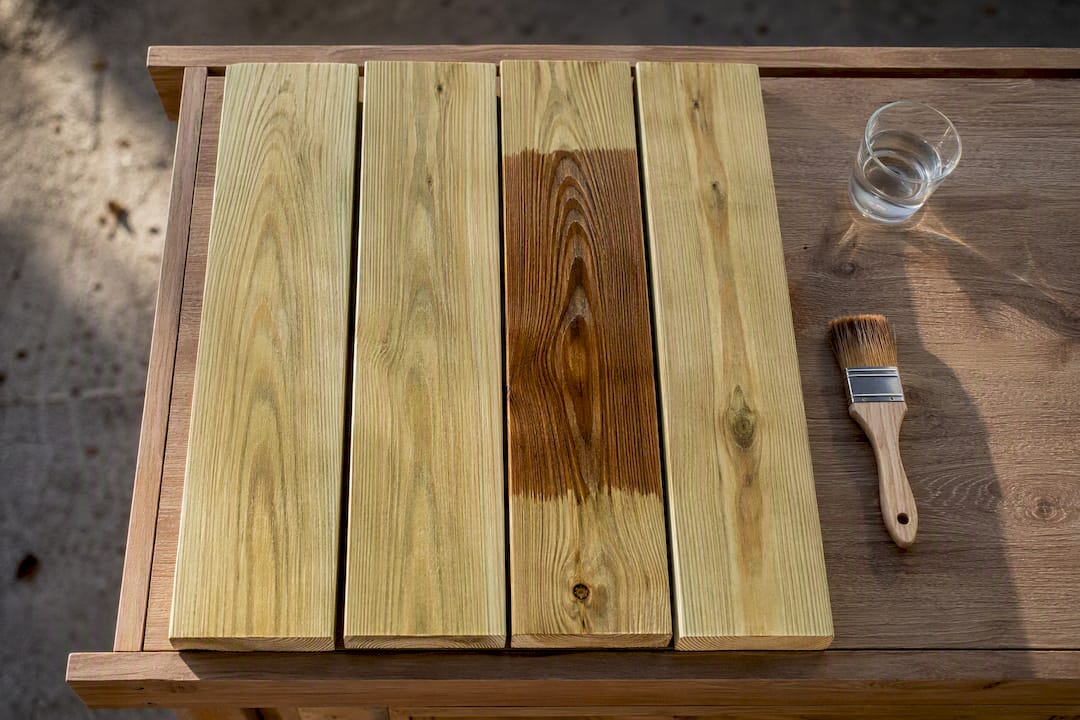
Cedar and redwood already have natural warmth and a tight grain worth showing off. Transparent or light semi-transparent finishes protect the wood without burying what makes it appealing; push cedar into a dark solid stain and it can shift toward an odd orange cast as it ages.
Dense hardwoods like ipe, teak, and mahogany behave differently altogether. Many general-purpose stains simply won’t absorb into wood this tight grained, and This Old House notes these species usually do best with transparent, penetrating finishes formulated specifically for hardwood rather than standard deck stain.
- Pressure-treated pine: mid-brown or warm gray neutralizes the green cast.
- Cedar/redwood: transparent or light semi-transparent preserves the wood’s natural color.
- Dense hardwoods: transparent, hardwood-specific penetrating stains only.
- Older, weathered boards with uneven color: semi-solid or solid to even things out.
Pro Tip: If your deck is a mix of old and new boards from a partial repair, a semi-solid or solid stain will do far more to blend the patchwork than any transparent option can.
Test Your Deck Stain Color Before Committing to the Whole Deck
Skipping this step is the single most common regret homeowners report. A color chip printed on cardboard tells you almost nothing about how that shade will look on your actual wood, in your actual light.
- Get sample cans or small test boards in your top two or three colors, at the opacity you’ve already chosen.
- Apply each to a few boards in different parts of the deck, including one area that gets full sun and one that sits in shade most of the day.
- Let each sample dry completely, since wet stain almost always looks darker and richer than the cured result.
- Photograph the samples morning, midday, and evening, then live with them for several days before deciding.
- If you’re trying to go lighter than an existing dark solid stain, plan to sand or strip first. A lighter color will not cover a darker solid finish; it will just look blotchy.
Pro Tip: Snap photos of your samples next to a paint chip from your siding. Screens and eyes both compensate for color context, and a side-by-side photo catches mismatches your eye might smooth over.
Prep, Recoating, and the Heat Factor
Color choice means little if the surface underneath isn’t ready. Clean the deck, repair any damaged boards, let it dry fully, and run a simple water test: sprinkle water on the wood, and if it beads up rather than soaking in, the deck isn’t dry enough or old sealant is still present. Sigma Painting’s guide to deck staining temperature covers the weather windows that affect cure time and final color.
Recoat timing follows the opacity ladder: transparent needs attention yearly, semi-transparent every 2 to 3 years, semi-solid every 3 to 4 years, and solid every 4 to 5 years, per BobVila’s testing. Full sun exposure, coastal salt air, freeze-thaw cycles, and heavy foot traffic all shorten those windows. Sigma Painting’s breakdown of how long deck stain actually lasts walks through which factors hit hardest.
Dark stains absorb more heat. Field tests cited by Carolina Renew report differences of 20 to 30-plus degrees Fahrenheit between light and very dark boards in direct sun, which matters a lot for bare feet near a pool deck. If you love charcoal but have kids running around barefoot, consider a mid-tone alternative instead.
- Water-based stains dry faster and clean up easier; oil-based stains often penetrate deeper into open-grain wood.
- Always check the product’s technical data sheet for coverage rates and application temperature before buying.
- Confirm local availability, since formulations vary by region and retailer.
Field Notes: What Sigma Painting Sees on Real Decks
The most common mistake isn’t picking a bad color. It’s picking one from a chip and skipping the test board entirely, then being surprised when the finished deck looks nothing like the sample. The second most common mistake is jumping straight to a very dark solid stain because it looks dramatic in photos, without accounting for how that color will perform in direct sun or how hard it is to lighten later.
Some projects genuinely call for a professional. Large decks, tricky access around railings and stairs, historic properties, or exotic hardwoods that need species-specific products are all situations where a color consult and a guaranteed finish save time and rework. For cedar specifically, Sigma Painting’s guide on staining a cedar deck covers opacity choices in more depth, and the Ontario re-stain schedule guide is worth a look for realistic maintenance timing in this climate.
Deck Stain Trends and What They Do for Resale Value
Warm, earthy tones and driftwood grays with brown or taupe undertones are leading 2026 palettes, and flat cool grays are losing ground. That shift matters beyond aesthetics. A deck that reads as intentional and current adds to a house’s curb appeal, and real estate agents consistently point to outdoor living space as one of the features buyers respond to fastest during a walkthrough.
The safest bet for resale isn’t necessarily the trendiest color. It’s the one that won’t look dated or clash with the house in five years. Warm mid-tone browns have stayed popular for decades because they’re close to how untreated wood naturally ages, so they never look jarring even as trends shift around them. Driftwood gray is newer to the mainstream but has staying power because it pairs with almost any siding color, brick, vinyl, or stone.
Where trends genuinely move the needle on value is at the extremes. A deck painted in a bold, unusual color like blue or bright green can actually hurt a sale, since buyers mentally price in the cost of redoing it. A deck stained in an overly dark solid black can read as high maintenance and can make a small deck feel smaller. The middle ground, warm brown or a soft gray at semi-transparent or semi-solid opacity, tends to appeal to the widest range of buyers while still looking current. If you’re staining a deck primarily to help a future sale, that’s the safer lane, even if a trendier charcoal tempts you for now.
Why the Same Deck Stain Color Looks Different by the Hour
The single biggest reason homeowners feel “tricked” by their stain choice is lighting, not the product. Morning light tends to be cooler and slightly blue, which can make a warm brown look flatter and less rich than expected. Midday sun is the most neutral light of the day and the closest to how a color chip is usually photographed, but it’s also the harshest, washing out subtle undertones in lighter stains.
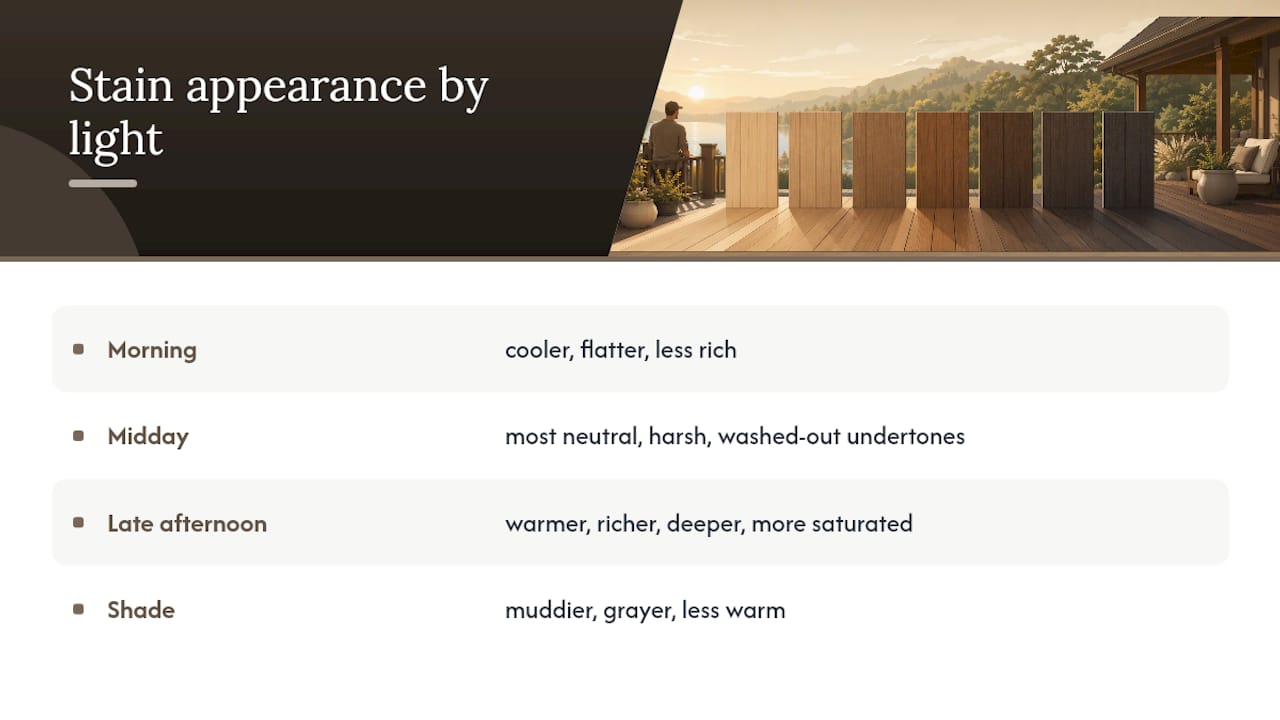
Late afternoon and evening light shifts warm and golden, and this is when most deck stains look their best, richer, deeper, more saturated. That’s also the window when most homeowners are actually outside enjoying the deck, which is worth factoring into how much weight you give an afternoon test versus a midday one.
Shade tells a different story entirely. A stain that looks warm and inviting in full sun can look muddier and grayer under a covered porch or a shade sail, since there’s less direct light bouncing warmth back at your eye. This is exactly why testing a sample only once, at only one time of day, leads to so many regretted stain choices. A color that looks perfect at 2 p.m. in July sun might look completely different on an overcast October afternoon, which is precisely when you’ll be looking at it most of the year in a lot of climates.
Coordinating Deck Stain With Furniture and Landscaping
A deck doesn’t exist in isolation. The stain color needs to work with whatever furniture, planters, and greenery sit on top of it, and that relationship is often overlooked until the furniture is already delivered and clashing.
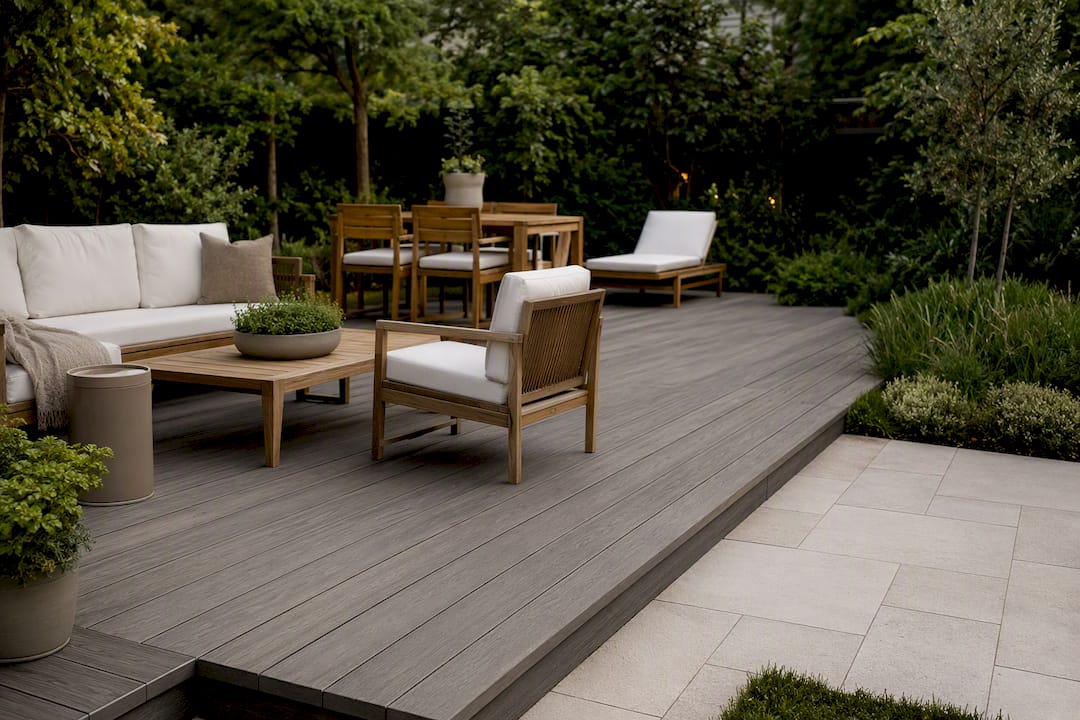
Warm brown and honey-toned decks pair naturally with black, dark bronze, or natural teak furniture, and they let colorful cushions and planters pop without competition. Driftwood gray decks are the most flexible option here. They read well with white, black, or natural wood furniture and don’t fight with almost any landscaping palette, which is part of why they’ve become such a common choice.
Charcoal and near-black decks look striking with light-colored furniture, white cushions, pale gray outdoor rugs, and green plants, since the contrast does a lot of the visual work. Pairing dark stain with dark furniture usually reads as heavy and can make an outdoor space feel smaller rather than more dramatic.
Landscaping matters just as much as furniture. A deck surrounded by heavy greenery and mulch beds tends to look best in warm brown or driftwood tones, since cooler grays can look sterile against soil and foliage. If your yard leans toward gravel, concrete pavers, or a more modern hardscape, a gray or charcoal deck often ties in more naturally than a warm brown would. Bringing a fabric swatch from your outdoor cushions to the paint counter, alongside your siding sample, is one of the simplest ways to catch a clash before it’s permanent.
Why Opacity Discipline Beats Chasing a Trendy Palette
Every trend cycles. Warm browns, cool grays, charcoal, they all take turns as the “it” color, but the opacity decision is permanent in a way color rarely is. Get the opacity wrong on an aging deck and no color choice fixes the maintenance headache that follows.
When in doubt, choose the more conservative opacity and the more moderate color. A mid-tone brown or gray at semi-transparent strength forgives more mistakes than a dramatic near-black solid ever will, and it gives you room to change your mind later without stripping the whole deck first.
— Enrico
Let Sigma Painting Handle the Color Decisions and the Labor
Homeowners may choose a professional color consultation that includes an on-site surface assessment, real sample boards applied to the actual deck, and a clear timeline and estimate before any work starts, so they’re never staring at a chip trying to imagine the final result.

You’ll walk away from a consultation with an opacity recommendation based on your deck’s actual condition, a shortlist of colors matched to your home’s undertone, and a firm quote. For decks with tricky access, historic details, or exotic hardwood, that kind of hands-on assessment usually saves more time than it costs. Get in touch through Sigma Painting’s deck and fence staining page to schedule a consult and see sample boards on your own wood before committing to a color.
Where to Verify Colors and Product Details
Manufacturer color browsers and technical data sheets remain the most reliable places to confirm real coverage rates, dry times, and how a specific product performs on different wood species. Cross-check any shade you’re considering against the maker’s own TDS rather than relying on in-store lighting alone. For safe disposal of leftover stain or old cans, Ontario homeowners can consult Product Care’s provincial program for drop-off locations and guidelines.
Sources
- How to choose wood stain colour — Benjamin Moore (Canada)
- The 6 Best Deck Stains of 2026, According to Hands-On Testing — BobVila
- How deck stain protects wood — This Old House
- ProductCare — Ontario
- Deck Stain Colors & Finishes for 2026: A Real Guide — TINOS Inc
FAQ
What are the best colors for deck stain?
Warm browns like cedar, chestnut, and honey, plus driftwood grays with brown or taupe undertones, are the most versatile choices because they pair with the widest range of siding and landscaping. The “best” color still depends on matching your house’s undertone and running one to three shades darker than the body color.
What is the most popular deck stain color right now?
Warm, earthy tones and driftwood grays with brown or taupe undertones lead 2026 trends, while flat cool grays have lost ground. Solid charcoal remains popular for contemporary homes but is a smaller share of overall choices than warm browns.
What are the most popular deck colors in 2026?
Cedar, chestnut, and warm walnut brown tones top the list, alongside driftwood gray shades with warm undertones rather than cool blue grays, according to current color trend reporting.
How do I know which opacity to choose for my deck?
Match opacity to your deck’s condition: transparent or semi-transparent for new or lightly weathered wood, semi-solid for moderate graying, and solid for older decks with cracking or heavy discoloration. When your deck falls between two categories, choosing the lighter opacity keeps more options open later.
Can Sigma Painting help me choose a deck stain color?
Yes. Sigma Painting offers on-site color consultations with real sample boards applied to your deck, plus a surface assessment and timeline, through its deck and fence staining service.