

Most deck stains last between 1 and 5 years, but that range depends almost entirely on which type you use and what your deck faces every season. Clear sealers and transparent toners typically need attention frequently. Semi-transparent stains usually hold up for a moderate time on horizontal surfaces. Semi-solid formulas last longer, and solid or opaque stains can last noticeably longer before needing a full recoat.
Oil-based stains tend to penetrate deeper into the wood grain, often providing better moisture resistance on rough or porous surfaces. Water-based formulas generally dry faster and clean up easier, but may wear sooner on dense or smooth wood than oil-based alternatives. Neither is universally better; the wood species and surface texture matter as much as the formula.
The simplest recoat trigger: splash a few tablespoons of water on the deck boards. If the water beads up and rolls off, the coating is still working. If it soaks in within a minute or two, it’s time to re-stain. Visible graying, color fade, or peeling are equally clear signals.
-
Clear sealer / transparent toner: shortest lifespan on horizontal surfaces
-
Semi-transparent stain: moderate lifespan
-
Semi-solid stain: somewhat longer lifespan
-
Solid / opaque stain: longest lifespan
Key Takeaways
Deck stain durability depends on stain type, surface exposure, and prep quality, with penetrating stains offering easier recoats and solid stains offering longer per-coat life at the cost of harder restoration.
| Point | Details |
|---|---|
| Lifespan ranges by type | Clear sealers last 1–2 years; semi-transparent 1–3; semi-solid 2–4; solid stains 3–5+ years on horizontal surfaces. |
| Water-bead test | Splash water on the deck; if it absorbs within 60–90 seconds, the coating has failed and re-staining is needed. |
| Solid vs. penetrating trade-off | Solid stains last longer per coat but require full stripping to recoat; penetrating stains fade rather than peel and recoat easily. |
| Prep determines performance | Consumer Reports’ multi-year tests show first-year stain performance predicts medium-term durability, making prep the highest-leverage step. |
| Sigma Painting | Sigma Painting provides professional deck staining in the GTA with thorough prep, premium products, and climate-aware scheduling. |
Table of Contents
- What shortens or lengthens a deck stain’s lifespan?
- What lifespan should you expect from each stain type?
- How do you know when it’s time to re-stain?
- Prep and application steps that actually extend stain life
- Routine maintenance that buys you more time between coats
- Best time of year to stain a deck in the U.S.
- When hiring a pro for deck staining makes financial sense
- Sigma Painting’s deck staining service in the GTA
- An honest take on the “longest-lasting stain” question
- Sources
What shortens or lengthens a deck stain’s lifespan?
The gap between a stain lasting 18 months and lasting 4 years usually comes down to a handful of controllable and uncontrollable factors. UV radiation is the dominant breakdown force. South-facing decks with no overhead shade take the hardest beating; the sun degrades the binder in the coating, causing color to fade and the film to crack. A pergola or mature tree canopy can meaningfully slow that process.
Moisture is the second major threat. Rain, morning dew, and freeze-thaw cycles all stress the coating bond, especially on horizontal boards where water sits rather than runs off. EPA guidance on mold and moisture makes clear that controlling moisture is central to exterior finish longevity. Mildew that takes hold under a failing coat accelerates wood degradation and forces a more aggressive prep job at recoat time.
Foot traffic creates uneven wear that most homeowners underestimate. The path from the back door to the stairs can look worn out in half the time it takes the shaded corner near the railing to show any change. Furniture legs, grill feet, and pet claws all concentrate abrasion in specific spots.
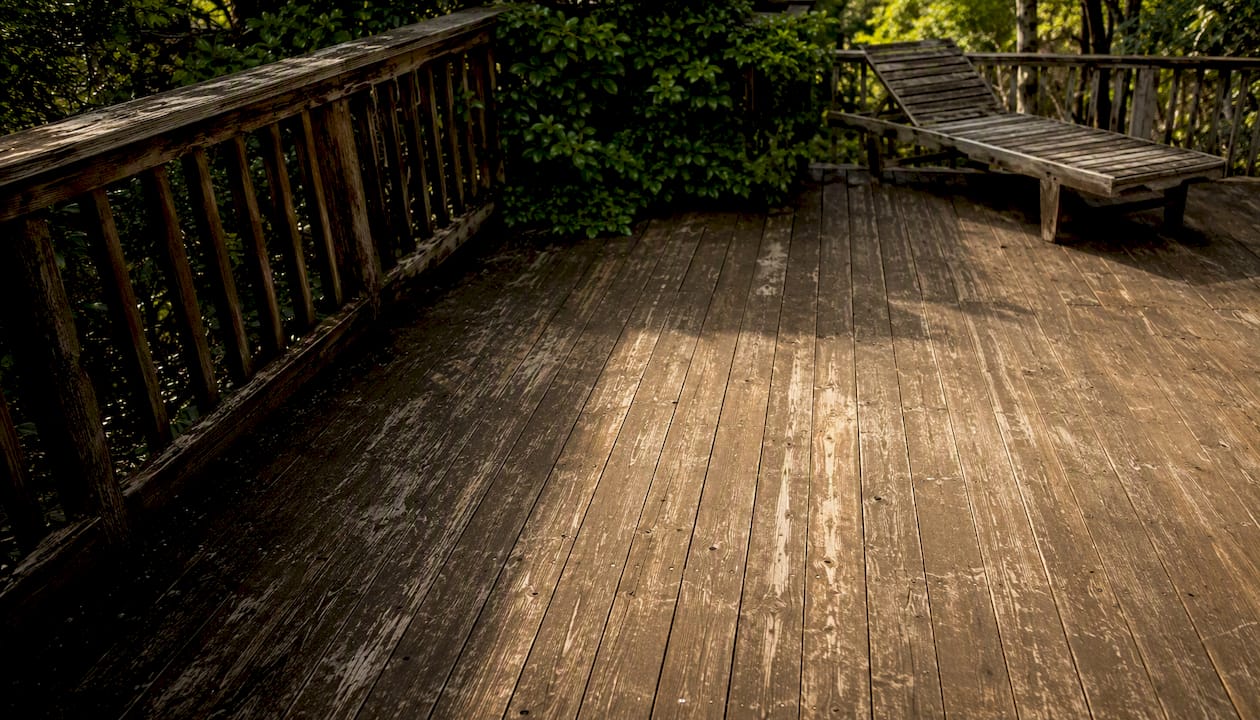
Wood species matters more than most product labels suggest. Pressure-treated pine and cedar are porous and accept stain readily, which helps adhesion but also means the coating can wear faster as the wood expands and contracts. Dense tropical hardwoods like ipe resist stain penetration, so adhesion is shallower and the coating may peel sooner if the surface isn’t properly prepared.
Film-forming stains (solid and semi-solid) create a surface layer that blocks UV well but can peel over time when moisture gets underneath. Penetrating stains (semi-transparent, transparent) soak into the wood and wear by fading rather than peeling, which generally makes recoating easier. The Canadian Wood Council notes that coating lifespan can range from a few months to over 20 years depending on product choice, application quality, and exposure conditions.
One detail worth knowing: a single deck often has multiple microclimates. The boards near the house door see constant foot traffic and shade. The far railing bakes in afternoon sun. Treating the whole deck as one uniform surface leads to either over-maintaining the sheltered areas or under-maintaining the exposed ones.
Pro Tip: Photograph your deck each spring. Side-by-side photos from year to year reveal fading and wear patterns that are easy to miss when you’re looking at the deck every day.
What lifespan should you expect from each stain type?
The table below reflects realistic horizontal-surface lifespans for each major category, how each type fails, and what recoating looks like in practice.
| Stain Type | Typical Lifespan (Horizontal) | How It Fails | Recoat Ease |
|---|---|---|---|
| Clear sealer | relatively short lifespan | Water absorption, graying | Easy; clean and reapply |
| Transparent / toner | relatively short lifespan | Color fade, graying | Easy; light clean and reapply |
| Semi-transparent | moderate lifespan | Fading, slight grain loss | Moderate; clean well, may need brightener |
| Semi-solid | longer lifespan | Fading, minor peeling at edges | Moderate to hard; may need stripping |
| Solid / opaque | longest lifespan | Peeling, cracking | Hard; often requires full strip before recoat |
Consumer Reports’ multi-year outdoor exposure tests confirm that solid stains generally hold appearance best through the first three years, and that first-year test results predict medium-term deck performance. Their methodology places stained pine boards on a roof to intensify weathering, which compresses real-world timelines into a testable window.
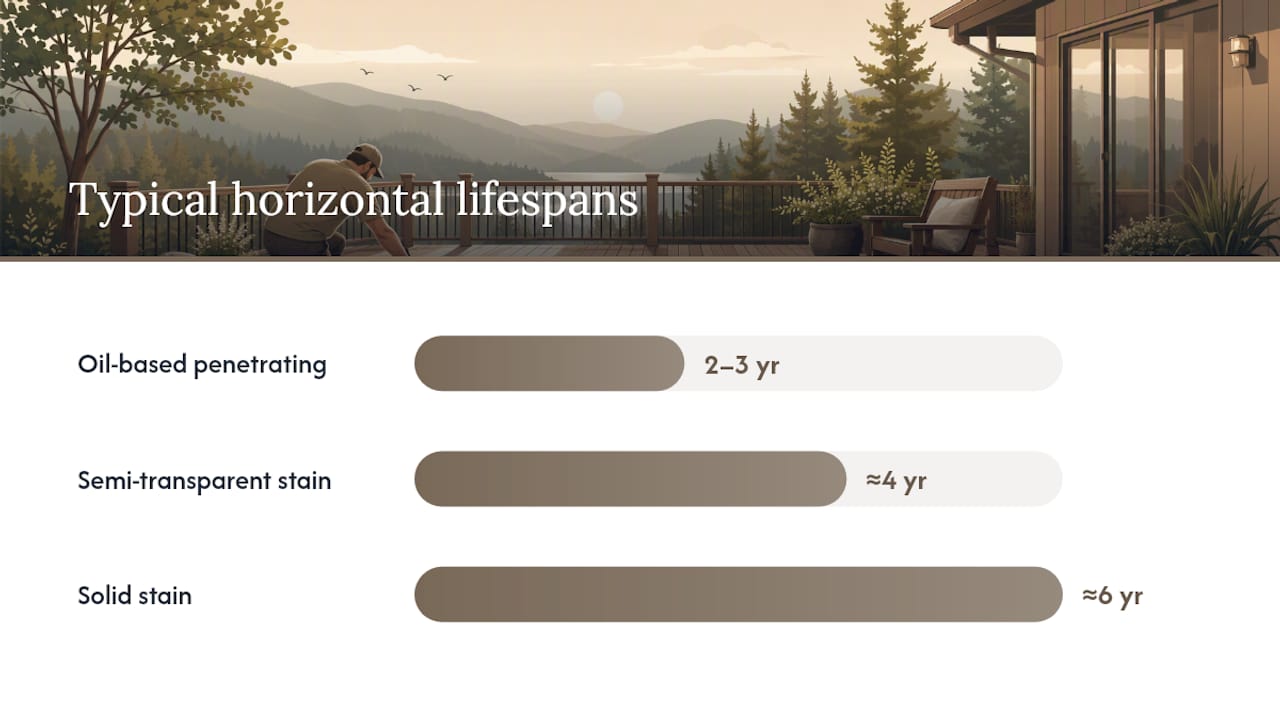
The DeckMath decision tool, using 2026-Q1 retail pricing, models semi-transparent stain life at roughly 4 years and solid stain life at roughly 6 years. Over a 10-year horizon, stains typically require fewer total applications than clear sealers, which often shifts the lifetime cost calculation in favor of stains despite their higher per-gallon price.
A few nuances the table doesn’t capture:
- Oil-based penetrating formulas on cedar or pressure-treated pine typically last 2–3 years on horizontal boards before moisture absorption becomes visible.
- Dense hardwoods like ipe or mahogany may see shorter adhesion life with film-forming stains because the wood’s natural oils resist bonding.
- Composite decking uses specialized coatings, not traditional wood stains, and the lifespan math is entirely different.
Vertical surfaces, including railings, fascia boards, and stair risers, routinely last 2–3 times longer than horizontal walking surfaces. They shed water instead of holding it, and foot traffic is zero. If your rails still look good when the deck boards are clearly fading, that’s normal.
How do you know when it’s time to re-stain?
Relying on a fixed calendar interval is one of the most common deck maintenance mistakes. A deck in Phoenix under a shade structure might go 4 years between coats. The same stain on an exposed deck in coastal Maine might need attention in 18 months. Homeowner-facing guides recommend using the water-bead test and visual checks rather than a set schedule, with most decks falling in a 1–3 year restain window.
The water-bead test:
- Wait for a dry day, at least 24 hours after any rain.
- Pour or splash a small amount of water (about ¼ cup) onto the deck boards in two or three different spots.
- Watch for 60–90 seconds.
- If water beads and sits on the surface, the coating is still repelling moisture.
- If water darkens the wood and absorbs within a minute, the coating has failed and re-staining is overdue.
Visual cues that confirm it’s time:
- Graying or silvering of the wood surface, which means UV has broken down the finish
- Noticeable color fade, especially uneven fading along high-traffic paths
- Loss of sheen on semi-solid or solid stains
- Mildew or dark spotting that doesn’t clean off with a standard deck wash
- Peeling or flaking on film-forming stains (solid or semi-solid), which signals moisture has gotten under the coat
- Splintering or raised grain, which means the wood itself is drying out
Spot-recoating high-traffic areas, the path from the door to the stairs, the area around the grill, is worth doing when those zones show wear but the rest of the deck still passes the water-bead test. Check the signs it’s time to repaint your exterior for a broader inspection checklist that applies to decks and other exterior surfaces.
Prep and application steps that actually extend stain life
How you apply stain matters as much as which stain you pick. A premium product applied over a dirty or wet surface will fail faster than a mid-grade product applied correctly.
- Clear the deck. Remove all furniture, grills, planters, and rugs. These trap moisture and create uneven wear.
- Sweep and clean. Use a deck cleaner formulated to remove dirt, mildew, and old finish residue. For mildewed wood, a cleaner with sodium percarbonate or oxygen bleach works without damaging wood fibers the way chlorine bleach can.
- Brighten grayed wood. A wood brightener (oxalic acid-based) restores the wood’s natural pH after cleaning and opens the grain for better stain penetration. Skip this step and the stain may not bond evenly.
- Sand if needed. Rough or splintered boards benefit from a light sanding with 60–80 grit before staining. Always sand with the grain.
- Dry completely. Wood must be dry before staining. Wait at least 48 hours after rain or washing. Check moisture content with an inexpensive wood moisture meter; most stain manufacturers recommend below 15% moisture content.
- Check the weather. Apply stain when daytime temperatures are between 50°F and 90°F, humidity is below 85%, and no rain is forecast for at least 24–48 hours. Avoid direct midday sun, which causes the stain to dry too fast and prevents proper penetration.
- Apply the right number of coats. Penetrating stains (semi-transparent, transparent) generally perform best with one to two coats; the wood should absorb the first coat before a second is added. Solid stains typically require two coats for full coverage and durability. Never apply a second coat over a wet first coat.
- Use a brush or roller, then back-brush. Sprayers speed up application but leave stain sitting on the surface. Back-brushing with a brush or roller works the product into the grain, improving adhesion and extending life. This step is especially important for penetrating stains.
For recoating, cleaning and brightening is usually sufficient if the existing coat is a penetrating stain in fair condition. Solid stains that are peeling require stripping before any new coat goes on. Applying a new solid stain over a peeling old one guarantees the new coat will peel too.
Pro Tip: Apply stain in the early morning or late afternoon when the wood is cool and shaded. Hot boards in direct sun cause the stain to flash-dry on the surface instead of soaking in, which cuts adhesion and shortens the coating’s life.
Consumer Reports’ multi-year roof-exposure tests show that first-year stain performance predicts medium-term durability, which means the prep and application decisions you make on day one have a compounding effect on how long the coating holds.
Routine maintenance that buys you more time between coats
Keeping a stained deck clean is the single most underrated longevity strategy. Organic debris, leaves, pollen, and soil hold moisture against the wood surface and accelerate coating breakdown. A quick sweep after storms and a thorough cleaning once or twice a year costs almost nothing compared to a full recoat.
-
Annual cleaning: Use a deck wash or mild soap solution and a stiff-bristle brush. This removes surface grime, pollen, and early mildew before it can penetrate the coating.
-
Mildew control: If you see dark spotting, treat it promptly with a deck cleaner containing sodium percarbonate. Left alone, mildew works into the wood and requires aggressive prep at recoat time. For persistent or widespread mildew, a professional cleaning is worth the cost.
-
Pressure washing: Safe at 500–1,200 PSI for most wood decks, held at least 12 inches from the surface and moving with the grain. Higher pressure or a zero-degree tip strips finish and raises grain, creating more work at the next recoat.
-
Spot recoating: High-traffic zones that fail the water-bead test before the rest of the deck can be spot-treated. Clean the area, let it dry fully, and apply one coat of the same stain. This extends the full-deck recoat by a season or two.
-
Furniture and grill pads: Use rubber or felt pads under furniture legs and a grill mat under the barbecue. These prevent the concentrated abrasion and heat that wear through finish faster than weather does.
Pro Tip: Move furniture to different positions each season. Furniture sitting in the same spot year-round creates a protected patch that looks different from the surrounding boards, making the deck look uneven even when the finish is technically intact.
Best time of year to stain a deck in the U.S.
Timing a stain job correctly is one of the easiest ways to get full value from the product. Apply in the wrong conditions and even a premium stain underperforms from day one.
- Best months: Late spring through early fall, roughly May through September in most U.S. climates. This window offers stable temperatures, manageable humidity, and long enough days for the stain to cure before overnight temperatures drop.
- High-humidity regions: In the Gulf Coast states and the Southeast, summer humidity regularly exceeds 85%, which slows drying and can trap moisture under the coat. In these areas, late spring (April to May) or early fall (September to October) often produces better results than midsummer.
- High-UV regions: In the Southwest, intense afternoon sun can flash-dry stain before it penetrates. Schedule application for early morning and plan to finish before noon.
- Temperature rules: Daytime temperatures should be 50°F or above during application and for at least 24 hours afterward. Overnight lows below 40°F within the first 48 hours of application can prevent proper curing.
- After rain: Wait at least 48 hours after any measurable rainfall before staining. For pressure-treated lumber or wood that was recently power-washed, 72 hours is safer.
- If rain hits right after staining: Light rain within the first 24 hours can wash away or streak a fresh coat. If this happens, let the deck dry fully and assess the finish. Uneven or blotchy areas will need a light cleaning and a touch-up coat once conditions stabilize.
- Foot traffic and furniture: Stay off a freshly stained deck for at least 24–48 hours. Wait 72 hours before replacing furniture, and a full week before placing rugs or mats that trap moisture.
A seasonal home maintenance calendar can help you plan staining alongside other exterior upkeep tasks so the timing aligns with your local climate rather than a generic schedule.
When hiring a pro for deck staining makes financial sense
DIY deck staining works well for straightforward jobs: a small deck in fair condition, a penetrating stain that doesn’t require stripping, and a homeowner with a free weekend and the patience to prep properly. Outside those conditions, the math often favors hiring a professional.
Peeling solid stains are the clearest case for calling in a pro. Stripping a solid stain requires a chemical stripper, a pressure washer, and often a sander, followed by brightening and drying time before any new product goes on. Done wrong, the new coat peels within a season. Professionals use industrial-grade strippers and pressure equipment that remove old film completely without damaging the wood surface.
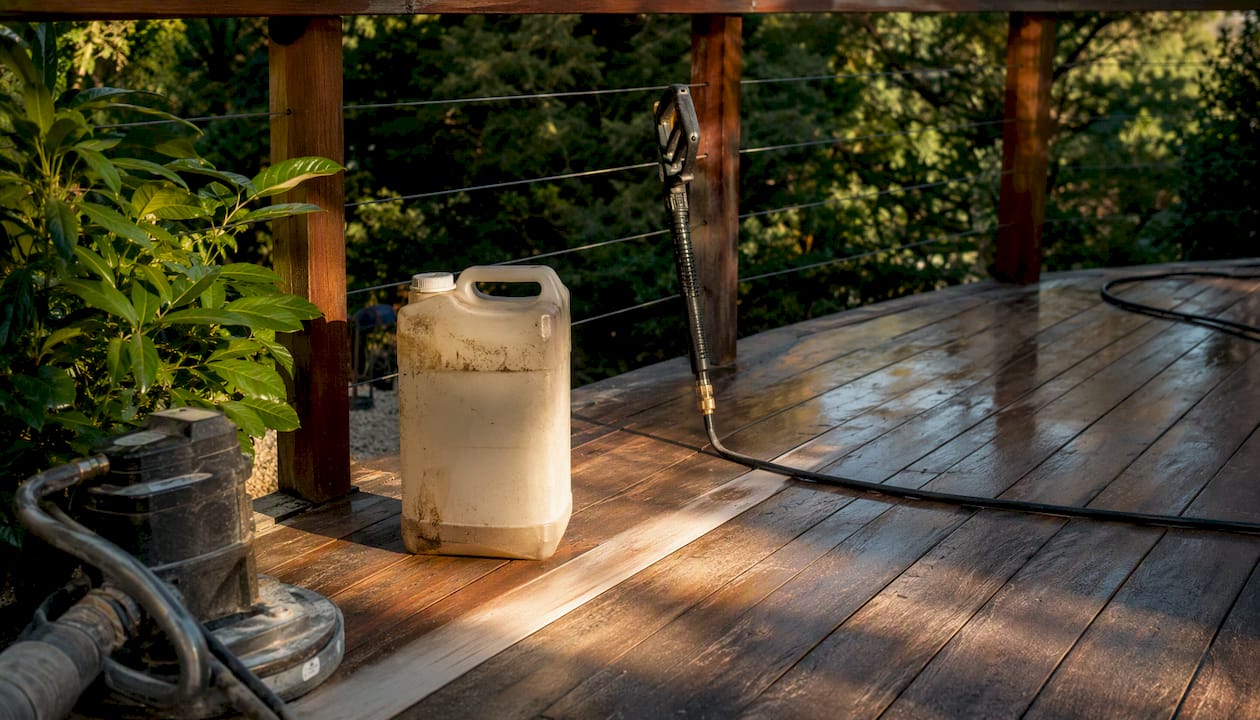
Large or complex decks, multi-level structures, decks with intricate railings, or decks attached to a home where overspray could damage siding, are also situations where professional equipment and experience reduce risk. A contractor who stains decks regularly will also have a sharper read on local climate windows, product selection for the specific wood species, and coverage rates that prevent both under-application and waste.
What pros do differently comes down to consistency. Even coverage, proper coat counts, and climate-aware scheduling are habits built through repetition. A professional who uses premium-grade staining products and applies them under controlled conditions will typically deliver a coat that reaches the upper end of the product’s rated lifespan, not the lower end.
Pro Tip: When vetting a contractor, ask specifically about their prep process for the existing finish. A contractor who plans to clean and recoat over a peeling solid stain without stripping first is a red flag, regardless of how good their references are. Use a homeowner’s checklist for choosing a painting contractor to ask the right questions before signing anything.
Hiring a reputable pro also reduces the total number of recoat cycles over a decade. A well-executed professional application that reaches year 4 or 5 beats two rushed DIY jobs that each fail at year 2.
Sigma Painting’s deck staining service in the GTA

Sigma Painting handles deck and fence staining across the Greater Toronto Area with the same prep discipline and premium product selection that defines every project on their roster. For homeowners who’ve read this far and know their deck needs more than a quick roll-on, Sigma Painting offers thorough surface prep including stripping, brightening, and drying assessment before a single drop of stain goes down. Their crews work with climate-aware scheduling, so your coat cures properly rather than being rushed between rain windows. If you’re also considering exterior painting or other protective coatings for the rest of your home’s exterior, Sigma Painting can bundle the work efficiently. Get a fast estimate with the instant quote calculator and see what a professional application costs before committing.
An honest take on the “longest-lasting stain” question
Most homeowners frame the deck stain decision as a durability contest: which product lasts longest? That framing leads a lot of people toward solid stains, and it’s not wrong, exactly, but it’s incomplete.
The real question is which stain costs you the least in time, money, and effort over a decade. A solid stain that lasts 5 years sounds better than a semi-transparent that lasts 3. But when that solid stain starts peeling at year 4, you’re looking at a full strip, a brightener application, drying time, and two coats of new product. The semi-transparent that faded at year 3 needed a cleaning and one coat. The labor gap between those two jobs is significant, especially if you’re hiring it out.
The DeckMath lifecycle calculator makes this concrete: over 10 years, a semi-transparent stain often requires fewer total applications than a clear sealer, and the recoat prep is far simpler than what a peeling solid stain demands. Longer per-coat life doesn’t automatically mean lower total maintenance burden.
My honest recommendation: if your deck is in good shape and you want the lowest-effort maintenance cycle, a quality semi-transparent or semi-solid penetrating stain is often the smarter choice than chasing the maximum years-per-coat number. Save the solid stain for situations where appearance uniformity matters more than recoat simplicity, like a deck with weathered or patchy boards that need the coverage.
Sources
The sources below are worth bookmarking if you want to verify lifespan claims, run cost comparisons, or dig into the science behind moisture and coating failure.
- Best wood stains from Consumer Reports tests
- Deck Stain vs Sealer Calculator — Decision Tool (2026) | DeckMath
- Performance Factors - The Canadian Wood Council - CWC
- Epa
- How Often to Stain a Deck: Recoat Guide


