
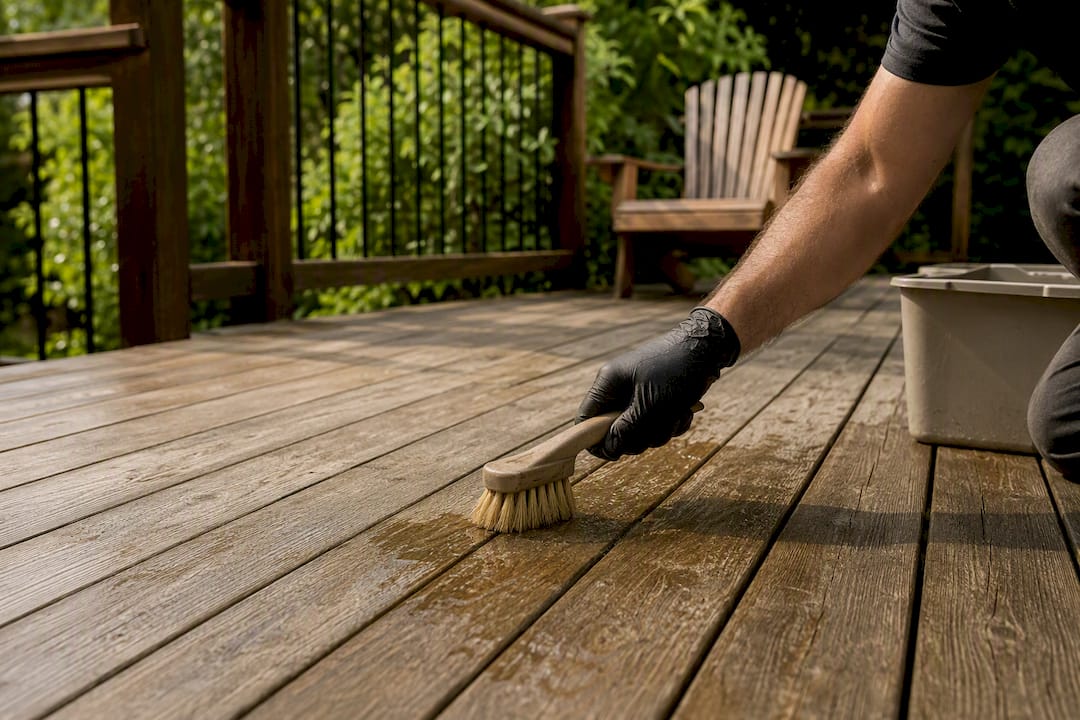
Expect to pay roughly between a low and moderate rate per square foot for professional deck staining, or a lower range per square foot if you handle it yourself. A typical 300 sq ft deck costs several hundred dollars with a contractor, or a smaller few hundred dollars in materials if you go the DIY route.
Deck condition drives everything else.
- Light prep (annual maintenance coat): stays near the low end of both ranges
- Heavy prep (stripping, sanding, board repairs): can double or triple the total
- If your deck just needs a wash and a fresh coat, DIY often makes sense
- If boards are cracked, graying unevenly, or the old finish is flaking, call a pro before you buy a single can of stain
Key Takeaways
Deck condition, rather than square footage alone, largely determines staining job costs, as preparation and repairs can substantially increase labor time and total price.
| Point | Details |
|---|---|
| Know your baseline rate | Budget $1.50 to $4.00 per sq ft for professional work, $0.50 to $1.50 for DIY. |
| Prep decides the final price | Stripping, sanding, and repairs can double or triple a routine maintenance quote. |
| Measure coated surface, not footprint | Rails, stairs, and spindles add real area that footprint-only estimates miss. |
| Compare quotes line by line | A complete bid lists moisture testing, prep, repairs, and two coats separately. |
| Sigma Painting prices by actual scope | Its deck and fence staining service quotes coated surface area with warranty-backed work across the GTA. |
Table of Contents
- Average Deck Staining Cost by Square Footage
- What Drives Deck Staining Price Up or Down
- DIY vs Professional Deck Staining: What You’re Actually Paying For
- Deck Stain Types and What They Cost Per Gallon
- What Should Be in a Professional Deck Staining Quote
- Sample Deck Staining Cost Calculations
- Why Proper Prep Changes the Lifespan of a Deck Stain Job
- Does Your Deck Material Affect Staining Cost?
- Get an Accurate Deck Staining Quote From Sigma Painting
- Frequently Asked Questions
- Sources
Average Deck Staining Cost by Square Footage
Per-square-foot pricing looks simple until you realize how much the “typical” number hides. On the low end, a clean, previously stained deck needing only a wash and one coat lands around $1.57 per square foot professionally installed, according to HomeGuide. On the high end, decks needing power sanding, stripping, and stain that soaks into weathered wood push past $4.00 per square foot. DIY generally runs $0.50 to $1.50 per square foot, mostly the cost of stain, brushes, and a weekend.
| Deck Size | DIY Total (Est.) | Pro Total (Est.) |
|---|---|---|
| 12x12 (144 sq ft) | $50 – $150 | $200 – $400 |
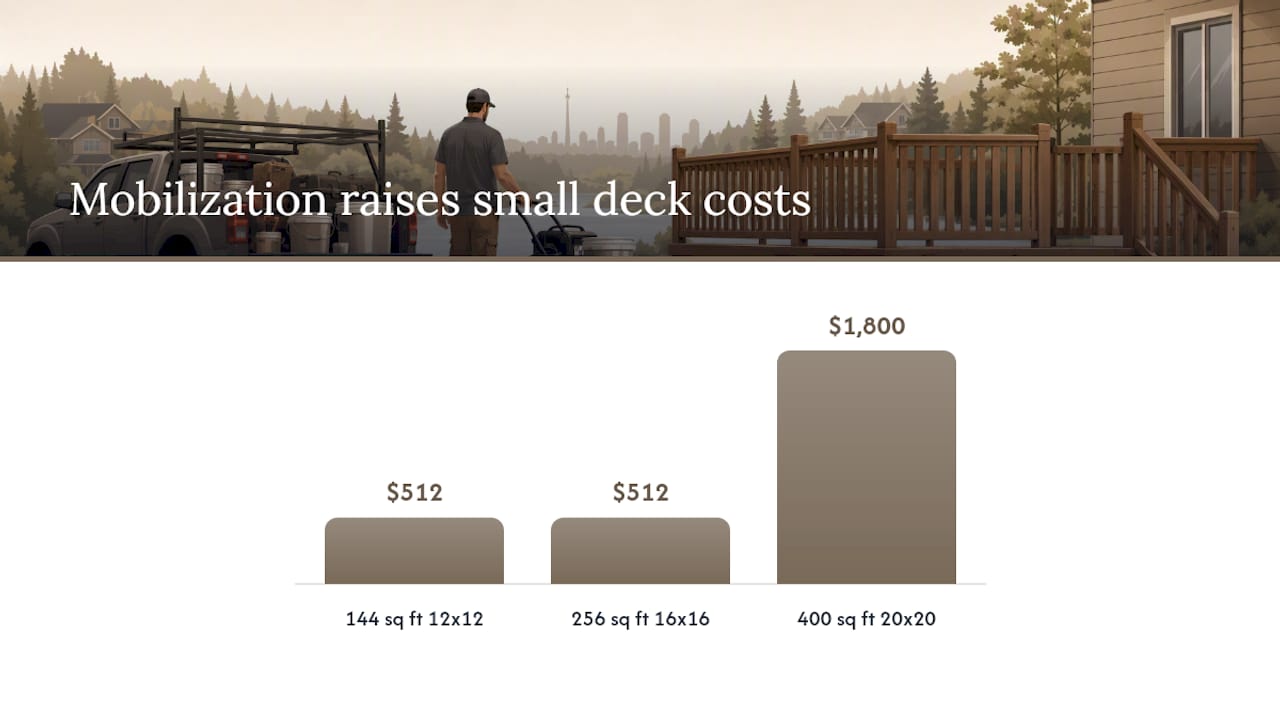
| 12x12 (144 sq ft) | $144 | $512 plus mobilization |
| 16x16 (256 sq ft) | $144 | $512 plus mobilization |
| 20x20 (400 sq ft) | $144 | $1,800 |
Notice how the smaller decks don’t scale down proportionally on the pro side. That’s mobilization cost at work: a contractor’s truck, crew time, and minimum job fee stay roughly fixed whether they’re staining 100 or 250 square feet, so a tiny deck often costs more per foot than a mid-size one.
Pro Tip: If your deck is under 150 sq ft, ask whether the contractor bundles it with rail or stair staining. Combining jobs spreads the minimum fee across more surface area and lowers your effective rate.
What Drives Deck Staining Price Up or Down
Square footage is the easy variable. The real cost swings come from what the deck needs before stain ever touches wood.
Power washing typically runs $0.35 to $0.77 per square foot when hired out, or about $38 a day to rent equipment yourself, per HomeGuide’s breakdown. Sanding adds $30 to $50 an hour and becomes unavoidable once a previous coat has started peeling or the wood has gone rough and silvery.
Then there’s the structural stuff:
- Rotted or split board replacement, charged by the board or linear foot
- Railing and spindle staining, priced separately since it’s slow, detail-heavy brushwork
- Loose fasteners or wobbly stair stringers that need fixing before finish goes on
A deck needing extensive stripping, sanding, and repair can cost double or triple what a routine maintenance coat costs, with labor alone often accounting for close to three quarters of the total bill on prep-heavy jobs.
Ontario adds one more wrinkle: a short staining season. Stain needs consistent dry weather and moderate temperatures to cure properly, which in most of the GTA means a window roughly from late May through September. Contractors booked solid in that window sometimes price accordingly, and rushed jobs squeezed in before a cold snap rarely hold up as well.
DIY vs Professional Deck Staining: What You’re Actually Paying For
A can of stain and a Saturday afternoon look cheap next to a contractor’s quote, until you total up what a pro visit actually includes.
| What’s Involved | DIY | Professional |
|---|---|---|
| Power washing | Rent unit (~$38/day) or hand-scrub | Included, commercial-grade equipment |
| Moisture testing | Usually skipped | Standard before staining |
| Sanding/stripping | Time-intensive, physically demanding | Crew-handled, faster turnaround |
| Masking/site protection | Basic tape and plastic | Full protection of siding, landscaping |
| Stain and materials | $50–$200, retail pricing | Often trade-priced, higher-grade product |
| Cleanup and disposal | Your responsibility | Included |
Moisture testing is the step most DIYers skip entirely, and it’s the one that determines whether stain actually bonds. Wood that reads above roughly 15% moisture content won’t absorb stain evenly no matter how good the product is.
Here’s a simple decision checklist:
- Deck under 150 sq ft, good condition, no repairs needed? DIY is reasonable.
- Multiple boards need replacing, or the old finish is peeling? Hire a pro.
- You don’t own or want to rent a pressure washer and sander? The labor savings of DIY shrink fast once you factor in rental costs.
- You want a warranty on the finish? Only a professional job typically offers one.
Deck Stain Types and What They Cost Per Gallon
Not all stain is priced or built the same. Penetrating clears and semitransparent stains soak into the wood grain and show off the natural texture; they run $20 to $50 per gallon and need recoating most often. Solid-color stains sit more like thin paint, hide wood imperfections, run $30 to $70 per gallon, and last longer between coats. Premium oil-based and hybrid formulas with UV inhibitors can reach $60 to $90 per gallon.
Coverage typically falls between 200 and 300 square feet per gallon, though weathered or rough-sawn wood soaks up noticeably more product than a recently sanded surface. Penetrating and semitransparent finishes rarely crack or peel the way paint does, but they do demand more frequent reapplication, according to Forest Products Laboratory testing.
- Buying the cheapest stain on the shelf often means restaining again in two years instead of four or five
- Better pigment loads and UV blockers cost more upfront but stretch the interval between jobs
What Should Be in a Professional Deck Staining Quote
A quote that’s just a single number per square foot tells you almost nothing. A proper one itemizes:
- Inspection and moisture testing
- Power washing
- Sanding or stripping (if needed)
- Repairs, called out separately
- Masking and site protection
- Two coats of stain, with product named
- Cleanup and disposal
Ask about warranty terms, exactly how much stain is included, the labor versus materials split, and whether there’s a minimum or mobilization fee. If a bid comes in unusually low, check whether prep and moisture testing are even listed. A rock-bottom price with a vague scope is often missing the steps that make the finish last, not evidence of a great deal.
Pro Tip: Ask contractors to measure “coated surface area,” not just deck footprint. Rails, stairs, and spindles add real square footage that a footprint-only estimate won’t capture, and it’s a common source of quote surprises.
Sample Deck Staining Cost Calculations
The math is straightforward once you know your numbers: square footage × per-square-foot rate, plus any fixed mobilization fee.
- 12x12 deck (144 sq ft), DIY, light prep: 144 × $1.00 average ≈ $144 in materials
- 16x16 deck (256 sq ft), pro, light prep: 256 × $2.00 average ≈ $512, plus mobilization
- 20x20 deck (400 sq ft), pro, heavy prep/strip: 400 × $4.50 average ≈ $1,800, reflecting stripping and repairs.
Adding rail and spindle staining typically increases costs per linear foot due to the detailed and labor-intensive nature of the work. A second coat, standard on most professional jobs, adds material cost but is what actually extends the finish’s lifespan.
- Change the sq ft number for your own deck
- Swap the per-foot rate based on condition (light vs heavy prep)
- Add a flat $150 to $300 if rails and stairs are included
Why Proper Prep Changes the Lifespan of a Deck Stain Job
The gap between a stain job that lasts two years and one that lasts five almost always comes down to prep, not the product label.
Skipping moisture testing is the single most common shortcut that shortens a deck finish’s life. Stain applied to wood that hasn’t fully dried after washing traps moisture underneath, leading to early peeling and blotching regardless of how good the stain itself is.
At Sigma Painting, deck and stair staining projects across the GTA follow a standard sequence: inspection, wash, a drying period verified with moisture testing, then premium stain application with full site protection.
- Site protection prevents overspray damage to siding, landscaping, and outdoor furniture
- Verified drying time before staining is what separates a two-year job from a five-year one
- Premium materials and correct application reduce the frequency of costly refinishing later
Does Your Deck Material Affect Staining Cost?
Wood species and deck material change both how much prep costs and how often you’ll need to restain. Pressure-treated pine, the most common decking material in Ontario, is porous and forgiving of stain but weathers unevenly, often needing a full strip-and-restain cycle every three to five years. Cedar holds color more evenly and resists rot naturally, but its softer grain can mean higher stain absorption, which raises material costs on a large deck.
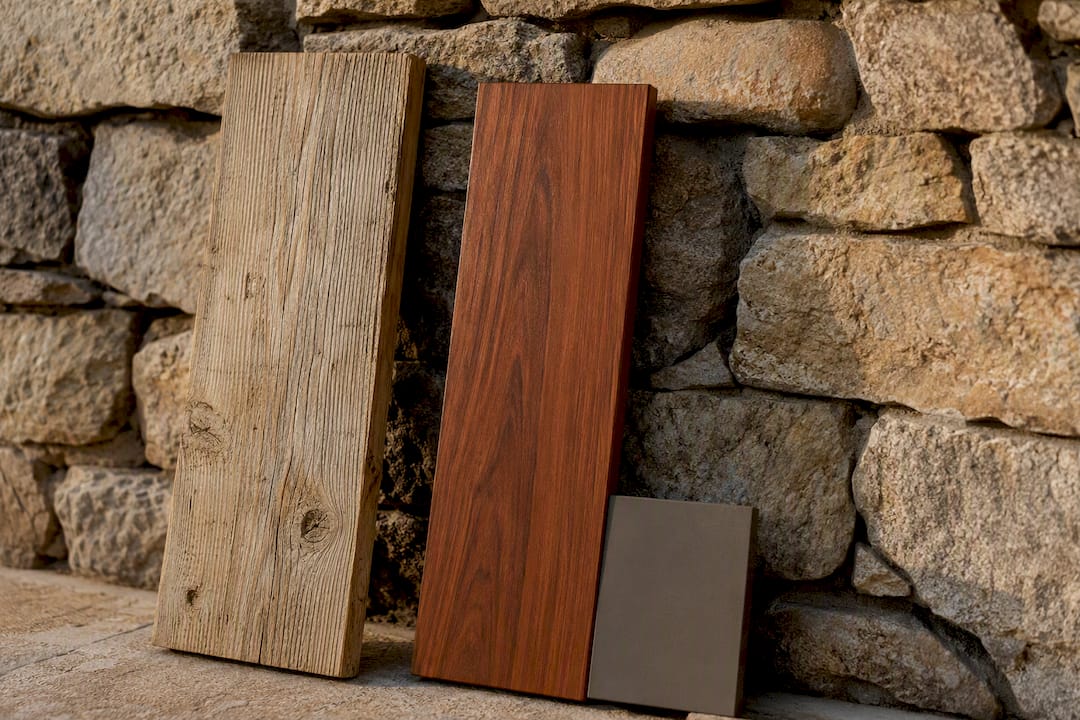
Composite decking is a different conversation entirely. Most composite products, sold under various brand lines, are engineered to resist fading and don’t require traditional staining at all. Occasionally a homeowner has a composite-wood hybrid railing system that does need staining, but the deck boards themselves typically just need cleaning. If you’re comparing new composite installation against restaining an aging wood deck, understanding composite decking’s upfront and lifecycle costs is worth doing before committing either way, since the two materials follow completely different maintenance-cost curves.
Older or hand-built decks with elaborate railing systems, benches, or planters add “coated surface area” well beyond the footprint, and complex builds are exactly where custom deck design choices made years earlier come back to affect today’s staining quote.
A pro’s take on the mistakes that cost homeowners the most
Most cost overruns trace back to one thing: skipping the wait between washing and staining. Rushing that step to save a weekend usually means paying for a full restain within two years instead of five.
Get an Accurate Deck Staining Quote From Sigma Painting
Sigma Painting prices deck and fence staining based on actual coated surface area and real prep needs, not a flat guess, so the number you’re quoted is the number you pay. That transparency matters most on older decks where hidden repairs or heavy stripping can otherwise turn into surprise add-ons mid-project.

Every project starts with an inspection and moisture check, then moves into premium-grade staining backed by a workmanship warranty, all handled by crews working across Pickering, Durham Region, and the wider GTA. Visit the deck and fence staining page to see the full scope, or run your deck’s dimensions through the instant quote calculator to get a real number in minutes.
Frequently Asked Questions
How much does it cost to stain a deck in Ontario? Professional deck staining typically costs $1.50 to $4.00 per square foot, meaning a mid-size deck often lands between $450 and $1,200 total, depending on prep needs and access.
Is it cheaper to stain a deck yourself? Yes, on materials alone. DIY staining runs $0.50 to $1.50 per square foot, but that excludes your time, equipment rental, and the risk of uneven results from skipped moisture testing.
How often should a deck be restained? Most wood decks need restaining every two to five years depending on stain type, sun exposure, and foot traffic. Solid stains last longer between coats than penetrating or semitransparent finishes.
Why do deck staining quotes vary so much between contractors? Quotes differ based on how much prep the deck needs, whether repairs are included, stain quality, and mobilization fees. A quote missing moisture testing or itemized prep is often lower for a reason.
Does composite decking need staining? No, most composite decking is engineered to resist fading and doesn’t require traditional staining, though attached wood railings or accents may still need it.
Sources
- Cost To Stain A Deck | HomeGuide
- Decks
- Forest Products Laboratory technical guidance (chapter on finishes)


