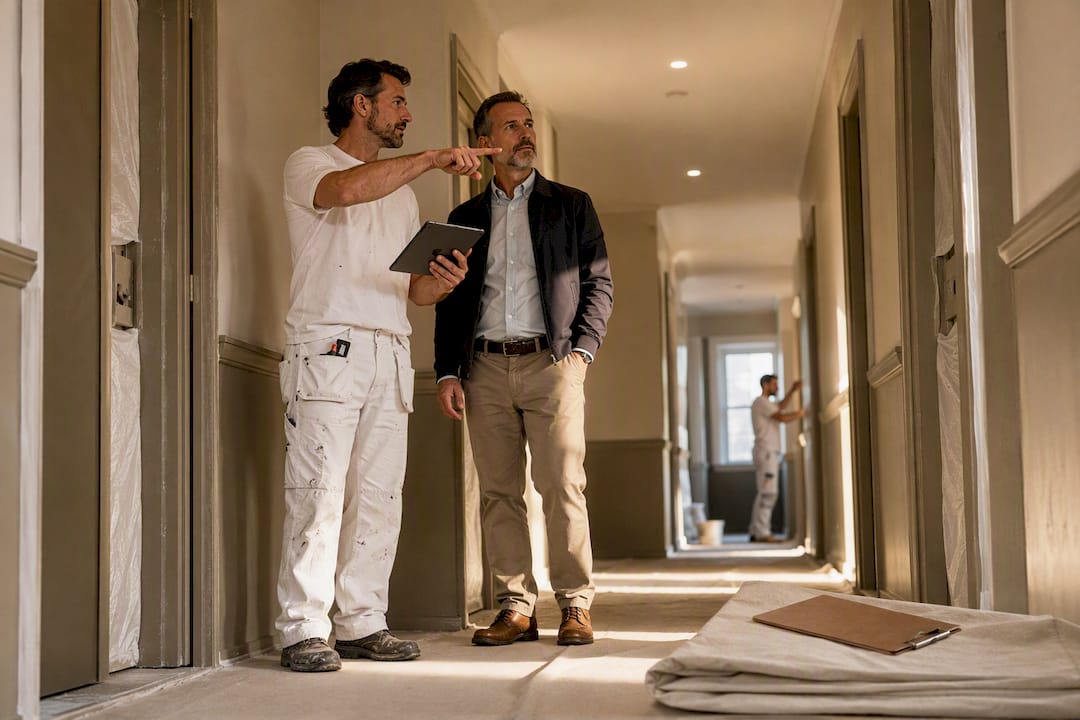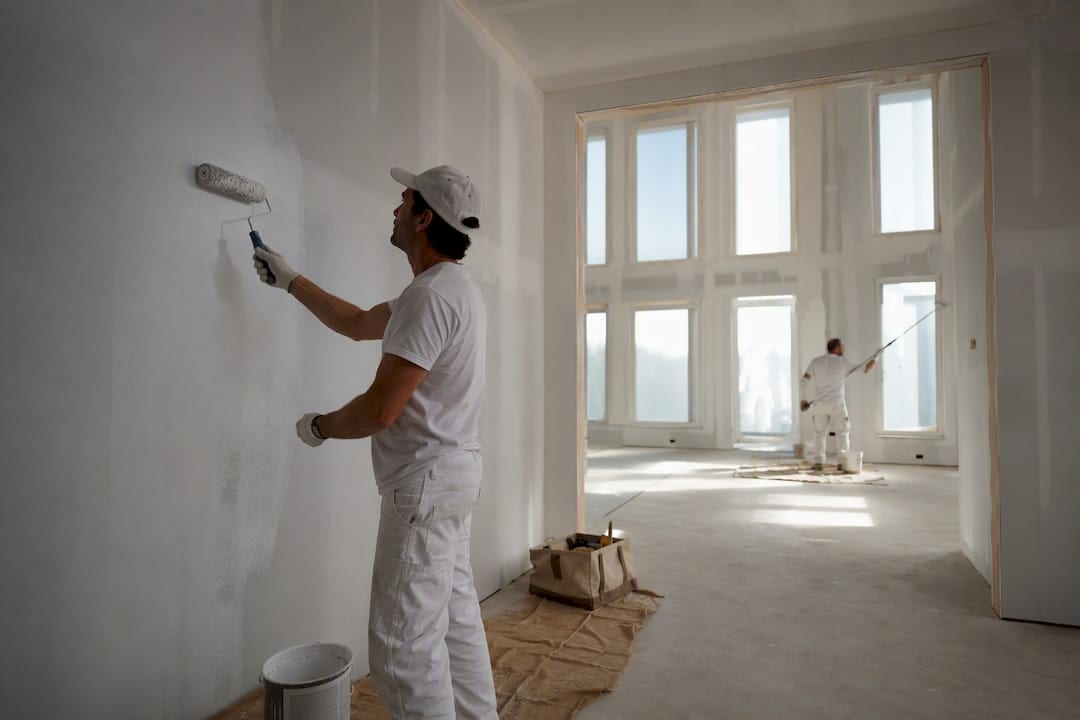

A paint color consultation is a professional service that delivers a tested, site-specific palette, physical samples, and clear application guidance so you avoid costly repaints. Here’s what you walk away with:
- A personalized color report with paint names, codes, sheen recommendations, and room-by-room placement instructions your painter can use directly
- Large-format physical samples shipped to your door for in-situ testing under your actual lighting conditions
- A written palette coordinated with your fixed finishes, reviewed and refined before a single drop of paint goes on the wall
At Sigma Painting, every contracted project includes a complimentary color consultation led by Enrico, drawing on premium brands like Benjamin Moore and Sherwin-Williams to match your space, not just your mood board.
Table of Contents
- What does a paint color consultation actually cover?
- What deliverables should you expect from a professional?
- How does the consultation process work, step by step?
- How do professionals choose colors, and what mistakes do they prevent?
- How should you prepare, and what questions should you ask?
- How painting teams use consultation outputs on a real project
- Key Takeaways
- When is a consultation worth it, and when can you skip it?
- Useful sources for further reading
- Sigma Painting includes color consultation in every project
What does a paint color consultation actually cover?
The term covers several distinct service formats, and the right one depends on your project size, timeline, and how much guidance you need.
| Format | What you get | Best for |
|---|---|---|
| In-person / in-home | Full site walkthrough, lighting assessment, fixed-finish review | Whole-home projects, commercial spaces |
| Virtual / video | Live screen-share session, pre-selected palette, samples mailed after | Single rooms, remote clients |
| Retailer-led email | Color chips and a digital palette emailed back | Quick refreshes, tight budgets |
| Sample-only guidance | Curated samples shipped with placement notes | DIY painters who know their direction |
Sherwin-Williams offers both free email consultations and paid 45-minute virtual sessions, with mailed color chips as a standard deliverable. Benjamin Moore’s virtual packages include 30-minute Zoom sessions with samples shipped afterward and optional image-rendering add-ons.
Single-room homeowners often find a virtual session sufficient. Whole-home projects and commercial properties benefit most from in-person visits, where a consultant can assess how light moves through connected spaces and how fixed elements like flooring and cabinetry interact with proposed colors. Property managers overseeing multi-unit buildings typically need color flow planning across corridors and common areas, which is difficult to do accurately from photos alone.
What deliverables should you expect from a professional?
A quality consultation produces documents and materials your painter can act on without guessing. Here’s what the standard package typically includes, and what sits behind a premium tier:
| Deliverable | Standard | Premium add-on |
|---|---|---|
| Personalized color report (names, codes, sheens, placement) | ✓ | — |
| Mood board / digital palette | ✓ | — |
| Large-format physical samples (2"×3" to 4"×4") | ✓ | — |
| Sample shipping (FedEx or USPS) | ✓ | — |
| Image rendering / room mockup | — | ✓ |
| Additional rooms beyond base scope | — | ✓ |
The color report is the most contractor-ready piece. It lists exact paint codes so there’s no ambiguity at the store, sheen specifications (flat, eggshell, satin, semi-gloss) matched to the surface type, and placement notes that tell your painter which color goes where. HOAs often require this level of documentation before approving exterior work.
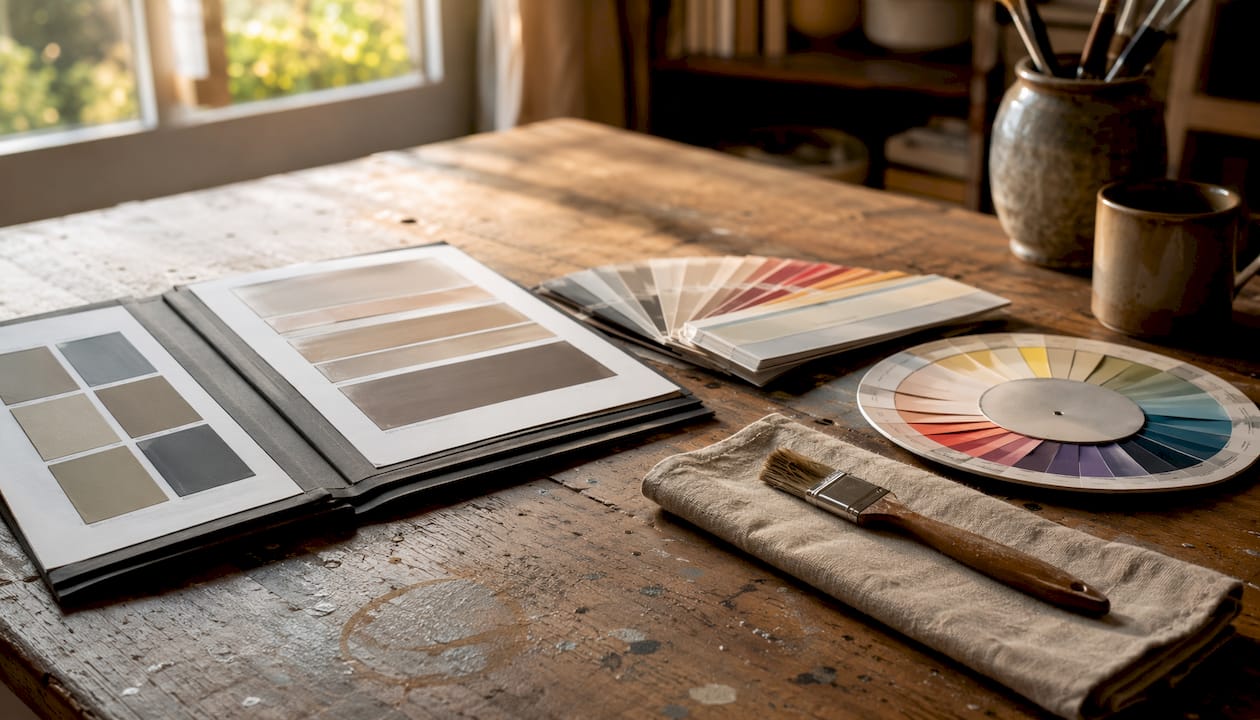
Physical samples shipped to your door are the safeguard that digital tools can’t replicate. A color on a screen or a 2-inch chip reads differently at full wall scale under your specific lighting. Mood boards and optional renderings help visualize the finished result, but the large sample tested in the actual room is what prevents regret.
How does the consultation process work, step by step?
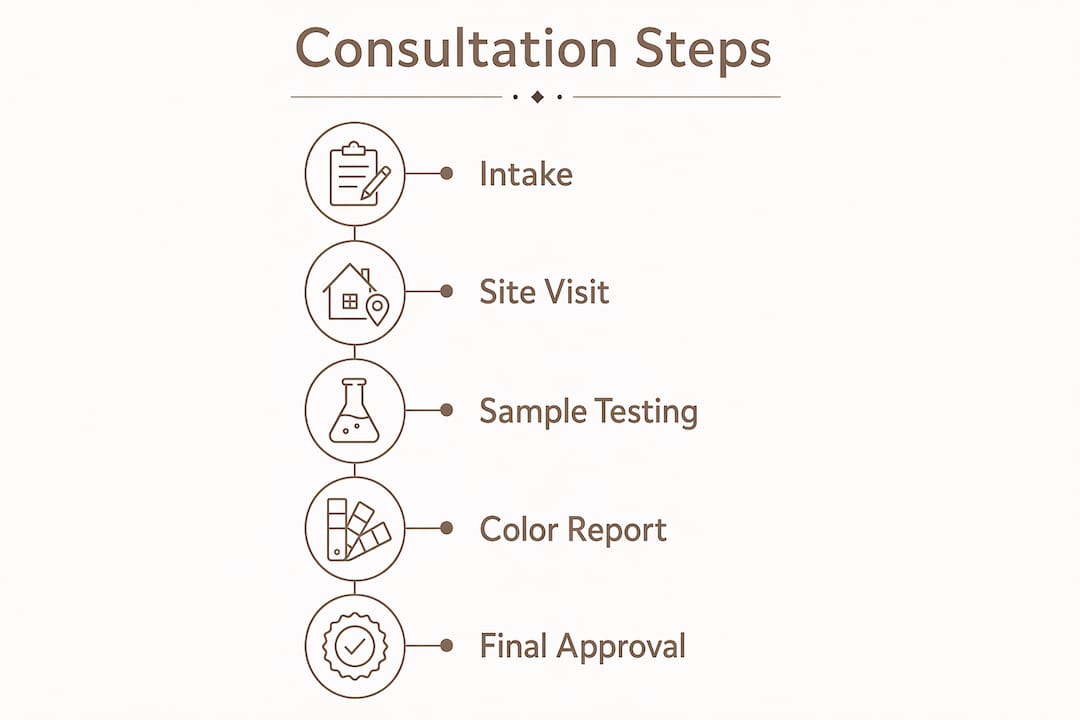
- Intake and questionnaire — You share your goals, style preferences, fixed finishes (flooring, countertops, cabinetry), and any constraints like HOA rules or existing furniture.
- Pre-work and photo review — Consultants request photos and measurements before the meeting so they can pre-select palettes and test undertones in advance.
- Consultation session — In-person or virtual, typically 45–90 minutes. The consultant walks through the palette, explains the reasoning, and takes notes on revisions.
- Sample shipment — Physical samples are mailed via FedEx or USPS, usually within a few business days of the session.
- In-situ testing — You tape samples to the wall and observe them at different times of day, in both natural and artificial light.
- Final report delivery — The written color report, paint codes, and sheen recommendations are delivered digitally, ready to hand to your painter.
Timeline from intake to final report typically runs one to two weeks, depending on sample shipping speed and how many revision rounds you need. Rendering add-ons can extend that by a few days. Pricing varies by format and scope: retailer email consultations are often free, virtual sessions from major brands run from roughly $50–$150, and independent or premium in-home consultants charge more for full-home scopes.
How do professionals choose colors, and what mistakes do they prevent?
Color selection isn’t intuition. Pros work from a set of tested principles that prevent the most common and expensive errors.
The 60-30-10 rule structures every palette: 60% goes to the dominant color (usually walls or a neutral base), 30% to a secondary (furniture, cabinetry, trim), and 10% to an accent. The point isn’t the exact numbers; it’s that one color clearly leads, one supports, and one punctuates. Rooms feel chaotic when two or three colors compete for dominance.
Undertones are the most common reason a color looks wrong after it’s on the wall. A white with a green undertone will clash with warm oak floors even if both look neutral in isolation. Checking undertones against countertops, flooring, and built-ins before committing is a non-negotiable step. The fix isn’t always switching colors; sometimes it’s adjusting the temperature of the secondary elements.
Light Reflectance Value (LRV) measures how much light a color bounces back. Pros prioritize LRV over hue alone when planning small or low-light rooms. Two colors that look similar on a chip can read dramatically different on a wall depending on their LRV. A higher LRV opens a space; a lower one anchors it.
Color flow matters most in open-concept homes and commercial corridors. Transitions between rooms should feel deliberate, not accidental. Consultants plan the full sequence, not just individual rooms.
Pro Tip: Test your shortlisted samples at three specific times: early morning with natural light, midday with overhead lighting on, and evening with lamps only. A color that passes all three is a safe choice. One that shifts dramatically between conditions will read inconsistently after painting.
For interior door colors and trim, the same undertone logic applies. Bring door and trim swatches to your consultation alongside countertop and flooring samples.
How should you prepare, and what questions should you ask?
Before your consultation, gather:
- Photos of every room from multiple angles, including flooring, cabinetry, and furniture
- Physical swatches or chips from countertops, tile, and upholstery
- Measurements of each room (width, height, ceiling height)
- Any HOA color restrictions or building management guidelines
- A short list of colors or styles you’ve already ruled out
Questions worth asking your consultant:
- What’s included in the deliverable, and is the color report formatted for a painter to use directly?
- How are samples shipped, and what’s the typical turnaround from session to delivery?
- How many revision rounds are included, and what do additional rounds cost?
- Do you specify sheen by surface type, or just by room?
- Can you provide references or before-and-after examples from similar projects?
Red flags to watch for: a consultant who skips in-situ sample testing and relies entirely on digital mockups, vague deliverables with no written color report, and no sheen or brand recommendations. Sheen matters as much as color for durability, especially in kitchens, bathrooms, and high-traffic commercial spaces. A consultant who can’t specify a brand is likely working from a generic palette rather than a tested one.
How painting teams use consultation outputs on a real project
The color report isn’t just a design document. At Sigma Painting, it becomes a scope-of-work item in the contract: exact paint codes, sheen specifications, and placement instructions are written into the project brief so there’s no ambiguity on site.
Premium paint brands matter here in a practical way. Benjamin Moore’s proprietary Gennex color technology delivers color accuracy that generic store-mixed alternatives can’t match. Sherwin-Williams products offer similar consistency at the professional tier. When a consultant specifies a Benjamin Moore color code, the painter pulls that exact formula, and the result on the wall matches what the client approved.
Sheen selection is where many DIY color decisions fall apart. Flat paint hides imperfections but won’t survive a kitchen wipe-down. Satin holds up in high-traffic areas. Semi-gloss is the right call for trim and doors. A professional consultation specifies the right sheen for each surface, not just the right color.
The most reliable signal of a quality consultation is a written color report your painter can execute without calling you for clarification. If the deliverable is a mood board and a verbal summary, you haven’t received a professional consultation — you’ve received design inspiration.
Pro Tip: Ask your consultant to flag any colors with LRV below 50 for rooms with limited natural light. These colors absorb more light than they reflect and can make a room feel smaller than it is, regardless of how good they look on the chip.
For a real-world example of how color selection plays out in a regional project, the Pickering exterior color guide walks through how architectural context and neighborhood palette shape the final recommendations.
Key Takeaways
A professional paint color consultation delivers a tested, written palette with sheen specifications and placement instructions, reducing repaint risk and giving your painter a clear brief to execute.
| Point | Details |
|---|---|
| Test samples in-situ | Tape large-format samples to the wall and observe them morning, midday, and evening before deciding. |
| Verify undertones and LRV | Check every color against fixed finishes and confirm LRV for low-light rooms to avoid costly surprises. |
| Get a written color report | The deliverable must include paint codes, sheen specs, and placement notes your painter can use directly. |
| Confirm shipping and timelines | Ask about sample shipment method and turnaround so you can plan your project schedule accurately. |
| Sigma Painting’s approach | Every contracted project includes a complimentary color consultation with premium brand recommendations built into the scope. |
When is a consultation worth it, and when can you skip it?
Skip the professional consultation for a single accent wall in a room with no fixed finishes you’re worried about. For anything larger — a whole-home repaint, a commercial space, a kitchen where the cabinetry cost more than your car — the consultation pays for itself by preventing one wrong color decision.
The real value isn’t the mood board. It’s the written report, the tested samples, and the sheen specifications that turn a design preference into a contractor-ready brief. Without that, you’re asking your painter to interpret your intentions, and interpretations diverge.
Useful sources for further reading
The following sources were used to build this guide and are worth bookmarking if you’re planning a consultation or comparing service formats:
- The Color Concierge — Detailed breakdown of online and in-person consultation formats, sample shipping logistics, and what a professional color report contains.
- Sherwin-Williams Color Services — Official page listing free email and paid virtual consultation options, deliverables, and pricing.
- Benjamin Moore Virtual Color Consultation — Manufacturer’s own consultation packages with Zoom session formats, sample shipment details, and rendering add-ons.
- Redfin: Choosing Paint Color for Your Home — Practical homeowner guidance on undertones, LRV, and testing samples against fixed finishes.
- Sherwin-Williams: How to Choose Paint Colors — Covers color flow planning for open-concept and multi-room projects.
Sigma Painting includes color consultation in every project
Color decisions are hard to undo. Sigma Painting’s interior painting services include a complimentary color consultation on every contracted job, so you get a tested palette, written color report, and sheen specifications before the crew arrives, not after.
For commercial clients managing multi-unit or large-scale projects, the same process scales up through Sigma Painting’s commercial painting services, with color flow planning built into the scope from day one. No separate consultation fee, no guessing at the job site.
Ready to see what your project will cost? Use Sigma Painting’s instant quote calculator to get a project estimate and start the conversation.